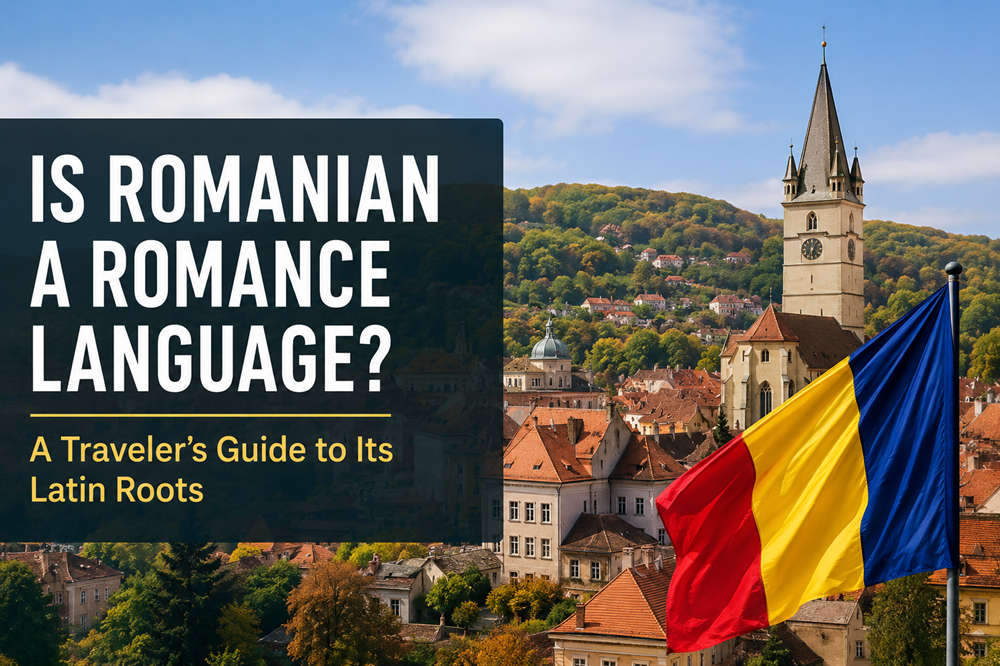
Is Romanian a Romance Language? A Traveler’s Guide to Its Latin Roots
Yes, Romanian is a Romance language. It developed from Latin and belongs to the same broad language family as Italian, Spanish, French, and Portuguese. What often surprises travelers is that Romanian developed in Eastern Europe, far from the geographic center of most other major Romance languages.
Centuries of contact with Slavic, Greek, Hungarian, Turkish, and other neighboring languages helped give Romanian its distinctive sound. Its history makes it feel both familiar and unexpected—especially to travelers who already know a little Italian, Spanish, or French.
What Makes Romanian a Romance Language?
Languages are classified according to their historical development, not simply by how they sound today. Romanian is considered a Romance language because it evolved from the everyday forms of Latin spoken within the Roman Empire.
The word “Romance” in this context comes from Rome. It has nothing to do with romantic love. Italian, French, Spanish, Portuguese, Catalan, and Romanian are all called Romance languages because each developed from spoken Latin in a different part of Europe.
Romanian preserves a substantial amount of Latin-derived vocabulary, along with grammatical structures that connect it to the wider Romance family. These inherited features matter more to linguistic classification than words borrowed later from neighboring languages.
Romanian is also the official language of Romania and an official language of the European Union.
Why Romanian Is an Eastern Romance Language
Romanian is often described as an Eastern Romance or Balkan Romance language. That label reflects its geographic development in southeastern Europe rather than a separate non-Romance origin.
Most of the Romance languages familiar to international travelers developed in Western or Southern Europe. Romanian evolved around the lower Danube and the wider Balkan region, where Romanian-speaking communities were surrounded largely by speakers of non-Romance languages.
Romanian is the largest surviving language in the Eastern Romance group. Related varieties include Aromanian, Megleno-Romanian, and Istro-Romanian. Scholars differ over whether some of these should be treated as Romanian dialects or as separate but closely related languages.
This eastern setting helps explain why Romanian followed a different path from Spanish, French, or Italian while remaining fundamentally Latin in origin.
How Romanian Developed from Balkan Latin
Roman rule brought Latin to parts of southeastern Europe, including the Roman province of Dacia, after its conquest under Emperor Trajan in the early second century.
The Latin spoken by soldiers, administrators, merchants, settlers, and local communities was not frozen in time. Like every living language, it changed as people used it in daily life. Regional forms of spoken Latin gradually developed into new languages throughout Europe.
Romanian emerged from the Latin varieties spoken in the Balkan and lower Danube region. Roman Dacia formed an important part of this history, although the precise territory in which early Romanian developed remains a complex subject of scholarly discussion.
That uncertainty does not affect Romanian’s classification. Linguists broadly agree that Romanian descended from Latin; the debate concerns the exact location and movement of early Romanian-speaking communities.
The earliest surviving Romanian texts date from the 16th century, long after the language had already developed its own identity. Romanian was once commonly written with a Cyrillic-based alphabet, but the modern language uses the Latin alphabet.
Why Romanian Sounds Different from Italian or Spanish
Romanian developed for centuries in close contact with languages spoken throughout Eastern Europe and the Balkans. These interactions added vocabulary, pronunciation patterns, and regional grammatical features to its Latin foundation.
Slavic influence is particularly noticeable. Slavic languages were spoken widely around Romanian-speaking communities, and Old Church Slavonic once played an important role in religion and written culture.
Romanian also absorbed words from Greek, Hungarian, Turkish, and German. French and Italian later influenced the modern literary language, especially during periods when Romanian scholars and writers emphasized the country’s Latin cultural connections.
Borrowed vocabulary does not determine a language’s family. English contains thousands of words derived from French and Latin but remains a Germanic language. Romanian similarly remains Romance despite its many Slavic and Balkan influences.
This mixture is one reason a traveler may hear a Romanian sentence, recognize one or two Latin-looking words, and still find the overall sound unfamiliar.
Romanian Compared with Other Romance Languages
Romanian shares historical roots with the other major Romance languages, but being related does not mean their speakers can communicate effortlessly. Similarities are often easiest to notice in individual words rather than complete conversations.
| Language | What May Feel Familiar | What Feels Different |
|---|---|---|
| Italian | Many shared Latin roots and some similar vowel patterns | Romanian grammar and Balkan-influenced vocabulary can make full sentences difficult to follow |
| Spanish | Recognizable words for family, numbers, objects, and everyday ideas | Pronunciation and historical sound changes differ considerably |
| French | Shared Latin vocabulary and later French influence on formal Romanian words | Spoken French and Romanian sound very different |
| Portuguese | Common Latin-derived roots appear in some vocabulary | The two languages developed in very different regions and linguistic environments |
An Italian, Spanish, French, or Portuguese speaker may be able to guess the meaning of certain Romanian signs or written words. Understanding natural spoken conversation is much harder without studying Romanian directly.
Romanian Words That May Look Familiar
Travelers can often see Romanian’s Latin connections in ordinary vocabulary. Some words resemble other Romance-language forms, while others may look familiar to English speakers because English also borrowed heavily from Latin and French.
| Romanian | English Meaning | Related Romance Word |
|---|---|---|
| familie | family | Italian: famiglia |
| important | important | Spanish: importante |
| restaurant | restaurant | French: restaurant |
| muzică | music | Spanish: música |
| noapte | night | Italian: notte |
| bun | good | French: bon |
| mare | large or great | Italian: maggiore has a related Latin history |
| vin | wine | French: vin |
These examples demonstrate a relationship, but they should not be treated as a reliable translation system. Related words can change meaning over time, and apparent similarities occasionally lead to incorrect guesses.
What Is Distinctive About Romanian Grammar?
Romanian has several features that distinguish it from the Western Romance languages travelers may know.
One of the clearest examples is the definite article—the equivalent of “the” in English. In languages such as French, Spanish, and Italian, the article normally appears as a separate word before the noun. Romanian generally attaches it to the end.
For example, oraș means “city,” while orașul means “the city.”
Romanian also marks some grammatical case distinctions that English and several Western Romance languages express differently. Noun forms can change depending on their role or relationship to another word in the sentence.
These structures matter when studying Romanian seriously, but short-term visitors do not need to master them. Memorized greetings, numbers, food words, and transportation phrases remain useful without a detailed understanding of the grammar.
How Much Romanian Do Travelers Need?
Most couples can visit Romania without speaking Romanian fluently. English is frequently used in established tourism settings, particularly at international hotels, major attractions, organized tours, and businesses accustomed to foreign visitors.
Availability still varies by person and location. English may be less dependable in smaller communities, local markets, rural guesthouses, independent restaurants, or unexpected transportation situations.
Romanian uses the Latin alphabet, which makes written information relatively approachable for English-speaking travelers. The alphabet includes five distinctive letters:
- ă
- â
- î
- ș
- ț
The letters ș and ț produce sounds broadly comparable to “sh” and “ts.” The vowels represented by â and î use the same Romanian sound, which does not have a simple English equivalent.
Romanian spelling is relatively consistent once you learn its basic sound patterns, although pronunciation cannot always be captured accurately through English-style phonetic spellings.
Before traveling, it is helpful to download Romanian for offline use in a translation app, save your accommodation address exactly as written locally, and learn several phrases that both partners can use independently.
Useful Romanian Phrases for Couples
A small collection of polite phrases can help with hotels, restaurants, transportation, and everyday interactions. You do not need perfect pronunciation to make a respectful effort.
| English | Romanian |
|---|---|
| Hello or good day | Bună ziua |
| Please | Vă rog |
| Thank you | Mulțumesc |
| Excuse me | Scuzați-mă |
| Do you speak English? | Vorbiți engleză? |
| We do not speak Romanian | Nu vorbim română |
| A table for two, please | O masă pentru două, vă rog |
| The bill, please | Nota, vă rog |
| Where is the train station? | Unde este gara? |
| How much does it cost? | Cât costă? |
| It is very beautiful | Este foarte frumos |
| Goodbye | La revedere |
Couples can divide the phrases by situation rather than expecting one person to handle every conversation. One partner might remember restaurant vocabulary while the other focuses on transportation and directions.
It is still worth placing the most important phrases in a shared phone note so that both travelers can find them quickly. Listening to native audio before departure is more useful than relying entirely on written pronunciation guides.
Why Learning a Little Romanian Is Worthwhile
Knowing only a few Romanian words can add useful cultural context to a trip. It can help you recognize place names, understand basic signs, order politely, and begin an interaction without immediately handing someone a phone.
Language preparation can also become an enjoyable part of planning together. Practicing phrases during the flight or testing each other before a restaurant reservation gives both partners a role in navigating the destination.
The goal is not to appear fluent. A clear greeting, a polite request, and a sincere thank-you are usually more practical than memorizing a long sentence that you cannot adjust when the conversation changes.
Romanian Is Latin at Its Core
Romanian is a Romance language descended from Latin, alongside Italian, Spanish, French, and Portuguese. Its development in Eastern Europe and its long contact with neighboring languages explain why it sounds different from its Western relatives.
Couples visiting Romania do not need fluency, but learning several greetings and practical phrases can make daily interactions easier. It also offers a more meaningful introduction to a language that carries both a Latin foundation and a distinctly Balkan history.