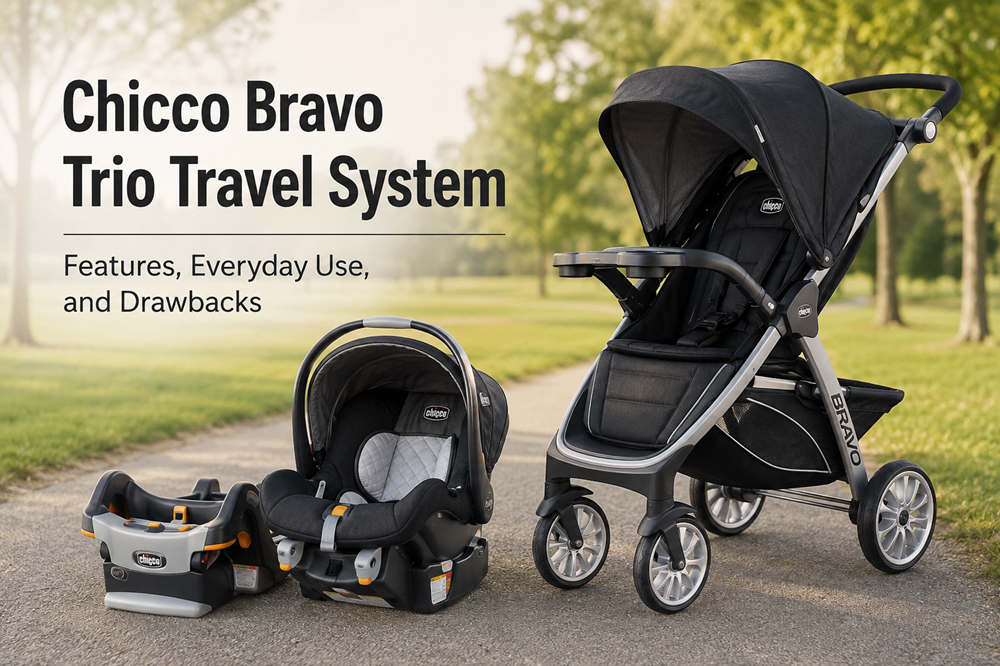
Chicco Bravo Trio Travel System: Features, Everyday Use, and Drawbacks
The Chicco Bravo Trio Travel System combines a full-size gned mainly for families who travel by car and want to move a baby between the vehicle and stroller without using a separate adapter.
The system offers generous storage, an easy folding mechanism, and three configurations that cover the infant and toddler stages. However, it remains a fairly substantial stroller, so its size should be considered before buying it for a small car, an apartment with stairs, or frequent air travel.
Chicco Bravo Trio Travel System at a Glance
| Included components | Bravo Quick-Fold Stroller, KeyFit 30 infant car seat, and stay-in-car base |
|---|---|
| Infant car seat limits | 4 to 30 pounds and up to 30 inches, subject to the fit requirements in the car-seat manual |
| Stroller limit | One child weighing up to 50 pounds |
| Stroller weight | 24.9 pounds with the toddler seat installed |
| Open dimensions | 35.2 x 22.8 x 42.7 inches |
| Folded dimensions | 15 x 22.8 x 36.8 inches with the child tray attached |
| Available configurations | Infant car-seat carrier, complete travel system, and toddler stroller |
These measurements and limits come from the official Chicco Bravo Trio specifications. Prices, colors, and fabric options can vary by retailer and may change over time.
What Comes With the Chicco Bravo Trio?
Bravo Quick-Fold Stroller
The stroller includes a forward-facing toddler seat, adjustable canopy, five-point harness, child tray, parent tray, storage basket, suspension, and rear parking brake. Its push handle can be adjusted to several positions for caregivers of different heights.
KeyFit 30 Infant Car Seat
The KeyFit 30 is a rear-facing infant carrier. It attaches to the stroller through the child tray without requiring an additional adapter. Removable newborn support is included for smaller infants who meet the requirements stated in the manual.
Stay-in-Car Base
The base is installed in the vehicle and remains there while the carrier is removed for errands or walks. Bubble level indicators and an adjustable leveling foot help establish the correct installation angle.
How the Three Travel Modes Work
Infant Car-Seat Carrier Mode
The toddler seat and its canopy can be removed, leaving a simpler stroller frame for the KeyFit 30. This arrangement is useful during the early months when the regular stroller seat is not yet needed.
Complete Travel-System Mode
The infant carrier can also be attached while the toddler seat remains on the frame. Parents do not have to remove and store stroller parts each time they switch between configurations, although this is the system’s bulkiest setup.
Toddler Stroller Mode
Once the infant carrier is outgrown, the Bravo functions as a conventional forward-facing stroller. Chicco advises using a compatible infant car seat for children younger than approximately six months rather than placing them directly in the toddler seat.
Folding, Lifting, and Storage
A handle beneath the stroller seat activates the one-hand fold. The front wheels rotate inward as the frame closes, and the folded stroller stands on its wheels without placing the push handle on the ground.
The self-standing design is useful in a garage, hallway, hotel room, or restaurant. Removing the child tray also reduces the folded height, which may help when loading the stroller beneath a cargo cover.
The folding motion is simple, but the resulting package is not especially light. Caregivers who regularly use stairs or lift a stroller into a tall vehicle should test a display model before purchasing.
Steering and Ride Quality
The Bravo has 7.5-inch front wheels, 10.3-inch rear wheels, treaded tires, and suspension on all four wheels. These features are intended for common surfaces such as sidewalks, shopping centers, paved paths, and occasional uneven ground.
It is still a full-size stroller, so maneuvering can require more room in narrow cafés, small stores, or crowded transit areas. The wheels are not designed for sustained use on sand, rough trails, or loose gravel.
The Bravo stroller manual specifies walking use and warns against jogging, skating, or other activities that could reduce control of the stroller.
Comfort for the Child
Reclining Seat
The stroller seat offers several recline positions. A more upright setting gives an alert toddler a clearer view, while a deeper recline provides a more relaxed position during a longer outing.
The seat does not become a structured bassinet or completely flat sleep space. Families who specifically want a newborn carrycot will need a different type of stroller.
Canopy
The adjustable UPF 50+ canopy includes a mesh peek-a-boo window. It gives the caregiver a view of the seat and allows some ventilation when the window is open.
Harness and Child Tray
A five-point harness secures the child in the toddler seat and should be adjusted for a close fit during every ride. The removable child tray provides cup holders and a small area for snacks or toys.
Convenience for Parents
The parent tray includes two cup holders and a covered compartment for small belongings. The storage basket can be reached from the front or rear and contains organizer pockets for separating smaller supplies.
Chicco limits the basket load to 10 pounds. Heavy bags should not be hung from the handle because added weight behind the stroller can affect stability.
The rear-linked parking brake helps keep the stroller stationary during stops. Caregivers should follow the operating directions provided with their particular stroller and confirm that the brake is engaged before letting go of the handle.
Using the KeyFit 30 in a Vehicle
The KeyFit 30 base can be installed with either the vehicle seat belt or the lower anchors, depending on the approved method for the selected seating position. The base must also be adjusted to the correct recline angle.
According to NHTSA’s infant car-seat installation guidance, an installed base should not move more than one inch from side to side or front to back when tested at the belt path. The car-seat instructions and vehicle owner’s manual should always be followed together.
After the carrier clicks into the base, pulling upward on it confirms that it has locked. Harness straps should lie flat at or below the baby’s shoulders, the chest clip should sit at armpit level, and the harness should be snug enough that extra webbing cannot be pinched at the shoulder.
The KeyFit 30 is outgrown when the child reaches one of its stated height, weight, head-clearance, or harness-fit limits. A taller baby may reach the one-inch head-clearance or height limit before approaching the maximum weight. The next seat should generally allow the child to continue riding rear-facing.
Everyday Travel With the Bravo Trio
Errands and Appointments
For stops at stores, clinics, or restaurants, the infant carrier can be moved directly from the installed base to the stroller. This can make short outings easier when a baby is already properly harnessed.
If the baby falls asleep, the car seat should not become a regular sleep space after the trip. The American Academy of Pediatrics advises moving a sleeping infant from a car seat or stroller to a firm, flat sleep surface on their back as soon as practical. Its current safe-sleep guidance explains the recommendation in more detail.
Neighborhood Walks
The wheel size, canopy, basket, and reclining seat make the Bravo suitable for routine walks on developed paths. The full-size frame is less convenient for homes where the stroller must be carried up several flights of stairs after every use.
Road Trips
The three-piece system works naturally for trips made mainly by car. The stroller can handle stops at hotels, parks, restaurants, and attractions, while the base remains installed in the vehicle.
Before a longer journey, it is worth packing the folded stroller with the expected luggage to make sure the trunk has enough usable space.
Airports and Public Transportation
The one-hand fold can help at a security checkpoint or boarding gate, but the Bravo is larger and heavier than a compact travel stroller. Carrying it on station stairs or loading it onto a shuttle may be difficult for one person.
The KeyFit 30 is labeled for aircraft use when installed according to its instructions. Seating restrictions, stroller-checking procedures, and family-travel policies vary, so travelers should review both the FAA’s child-restraint guidance and the individual airline’s rules before departure.
Important Drawbacks to Consider
- It is relatively heavy. The folding mechanism is easy to operate, but the stroller may still be tiring to lift repeatedly.
- It occupies considerable cargo space. The large wheels and full-size frame may not suit a small trunk or storage closet.
- The toddler seat is not reversible. Once the infant carrier is no longer used, the child rides facing forward.
- It has no true bassinet. The reclining stroller seat does not replace a dedicated newborn carrycot.
- It is not a jogging stroller. Its suspension is intended for walking rather than running or rugged trails.
- Taller babies may outgrow the infant carrier earlier. The KeyFit 30’s fit requirements can be reached before its maximum weight.
Who Is the Chicco Bravo Trio Best For?
The Bravo Trio is a strong match for families who travel primarily by car and want a straightforward stroller-and-infant-seat combination. It is particularly useful for suburban errands, paved walks, medical appointments, shopping trips, and road travel.
It may also appeal to caregivers who prefer built-in trays, an accessible basket, adjustable handle height, and a stroller that remains useful after the infant seat is outgrown.
Who May Prefer a Different Travel System?
A lighter stroller may be more practical for families who live in a walk-up apartment, rely heavily on buses and trains, use a very small vehicle, or fly frequently.
Another model may also be more suitable for parents who want a reversible toddler seat, a separate bassinet, a single-to-double configuration, or wheels designed for jogging and rough terrain.
What to Check Before Buying
- Measure the trunk. Compare the cargo opening and usable depth with the stroller’s folded dimensions.
- Test the lifting weight. Fold and lift a display model as you would when loading it into your vehicle.
- Check the vehicle fit. Make sure the base can achieve the required angle without making the front passenger area impractical.
- Try the handle positions. Each regular caregiver should be able to push comfortably without hunching.
- Review the infant-seat limits. Consider the baby’s height as well as weight.
- Confirm the exact package. Similar product names may include different infant seats, fabrics, or accessories.
- Inspect used equipment carefully. Check expiration dates, recalls, missing parts, manuals, and crash history before using a secondhand car seat.
Final Verdict
The Chicco Bravo Trio is best suited to car-centered families who want an uncomplicated infant-seat connection, useful storage, and a stroller that can continue into the toddler years. Its full-size weight and folded dimensions make it less appealing for frequent flights, stair-heavy routines, small trunks, or rough terrain.