
18 Best Travel Games and Activities for Kids on Flights and Road Trips
Keeping children entertained while traveling is easier when the activity suits the journey. A game that works well on a hotel table may be frustrating in a moving car, while a quiet solo puzzle may be ideal for a flight but less engaging for family game night.
The best travel games for kids are compact, easy to pause, and simple to pack away. The options below include contained activities for preschoolers, portable family games, solo puzzles, and verbal games that require no supplies.
What Makes a Good Travel Game for Kids?
A useful travel game should fit the child, the available space, and the length of the journey. Before packing one, consider whether it can be played quietly, stopped without warning, and stored without losing important pieces.
Look for:
- Compact or flat packaging
- Short or flexible rounds
- Rules children can learn quickly
- Few loose components
- A secure case, pouch, or tin
- Enough variety for repeated play
Always check the manufacturer’s age guidance. Games containing small tiles, dice, magnets, or tokens may be unsuitable for younger children. The U.S. Consumer Product Safety Commission’s small-parts guidance explains that certain small components can create choking, swallowing, or inhalation hazards for children under three.
Best Travel Games and Activities for Kids Ages 3–5
Preschool travel activities should be visual, simple, and manageable without lengthy instructions. Contained pieces are especially helpful in airplanes, restaurants, and busy waiting areas.
1. Melissa & Doug Water WOW! Take-Along Set
Suggested age: 3–6
Players: One
Best for: Flights, restaurants, and airport waits
The Water WOW! Take-Along Multi-Activity Drawing Set uses a refillable water pen to reveal colors, pictures, drawing prompts, and search-and-find scenes. The surfaces can be used again after they dry.
A zippered case holds the pen, reusable cards, stamps, and stencils, making it easier to manage than loose art supplies. Fill the pen before boarding or leaving the hotel.
Main limitation: The pen requires access to water when it needs refilling.
2. Mudpuppy Happy Camper Magnetic Play Set
Suggested age: 4+
Players: One
Best for: Airplane trays and train tables
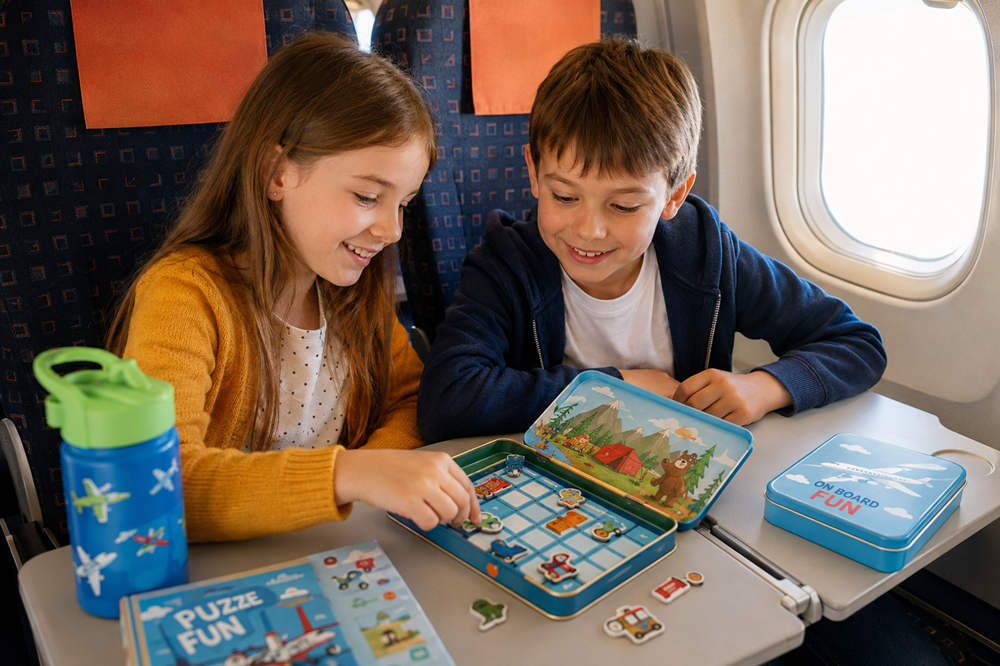
The Happy Camper Magnetic Play Set includes illustrated camping scenes and 45 magnets that children can use to dress and arrange animal characters.
The hinged tin acts as both the playing surface and storage case. Because the magnets attach to the tin, they are less likely to slide away during ordinary movement.
Main limitation: The set still contains many small pieces that should be counted before leaving.
3. Melissa & Doug Sticker WOW! Activity Pad
Suggested age: 3–7
Players: One
Best for: Restaurants and short travel breaks
Sticker WOW! uses a refillable stamper to place surprise stickers onto matching, counting, and search-and-find pages. The stamper stores with the pad, so children do not need to handle separate sticker sheets or peel away paper backings.
It is easy to start and stop when food arrives or boarding begins. A standard pad includes hundreds of stickers, although the precise character and page design vary by edition.
Main limitation: The stickers are not reusable and eventually require a refill.
4. Mudpuppy Wild Bingo
Suggested age: 4+
Players: Two
Best for: Trains, flights, and hotel downtime
Wild Bingo replaces numbered bingo balls with illustrated animals. Players spin the arrow and cover the corresponding pictures on their boards.
The game comes in a magnetized tri-fold package with a spinner and magnetic markers. Its picture-based rules make it accessible to children who are not yet confident readers.
Main limitation: It is designed for two players rather than a larger family group.
Best Travel Games for Kids Ages 6–8
Children in this age range can usually manage more structured rules, friendly competition, storytelling, and introductory strategy.
5. Spot It!
Suggested age: 6+ for the classic edition
Players: Two to eight
Best for: Airports, restaurants, and hotels
In Spot It! Classic, any two cards share one matching symbol. Players compete to identify that symbol first.
The compact deck includes several ways to play, and rounds can finish quickly. It is useful when a family has only a few minutes before boarding or needs an activity that can stop when food arrives.
Main limitation: Excited players may become loud, so pointing instead of shouting works better in quiet spaces.
6. Rory’s Story Cubes
Suggested age: 6+
Players: One or more
Best for: Creative children and mixed-age families
Rory’s Story Cubes contains nine dice printed with pictures. Players roll the dice and connect the visible images in a story.
There is no fixed playing time or single correct answer. One child can tell a short tale alone, or several family members can take turns adding chapters.
Main limitation: Roll the dice inside a shallow container so they do not bounce into an aisle or under a seat.
7. UNO
Suggested age: 7+
Players: Two to ten
Best for: Hotels, cruise cabins, and vacation rentals
UNO is easy to teach because players mainly match cards by color or number. Action cards add unpredictability without requiring a large playing area.
The deck is compact and works well for families with children of different ages. Current standard cards also include graphic symbols that make colors easier to identify.
Main limitation: Players need room for their hands, a draw pile, and a discard pile.
8. Guess in 10: World of Animals
Suggested age: 6+
Players: Two or more
Best for: Road trips and family waiting time
In Guess in 10: World of Animals, players identify an animal by asking up to 10 questions. Useful questions might cover habitat, size, diet, movement, or physical features.
One person can hold the cards while everyone else plays verbally, so it does not always require a table. Other editions cover subjects such as countries, sports, and space.
Main limitation: The difficulty changes by theme, and some editions require more background knowledge.
9. SmartGames IQ Puzzler Pro
Suggested age: 6+
Players: One
Best for: Quiet solo play
IQ Puzzler Pro includes 120 two-dimensional and three-dimensional challenges. Players copy the starting arrangement shown in the booklet and fit the remaining pieces into the board.
The puzzle pieces and booklet store in a lidded travel case. It is a practical choice for children who prefer solving problems independently.
Main limitation: Looking down for an extended period may be uncomfortable for a child who experiences motion sickness.
Best Travel Games for Kids Ages 9–12 and Teens
Older children often enjoy games involving wordplay, memory, deduction, or light strategy. These choices remain portable without feeling designed only for younger travelers.
10. Vacation Fun Mad Libs
Suggested age: 8–12
Players: One or more
Best for: Flights and train journeys
Vacation Fun Mad Libs contains 21 fill-in-the-blank stories involving hotels, national parks, caves, and other travel themes.
One person asks the group for nouns, verbs, adjectives, and other words before reading the completed story aloud. It can also be completed independently by a confident reader.
Main limitation: Younger children may need help understanding parts of speech.
11. Kanoodle
Suggested age: 7+
Players: One
Best for: Airports and quiet hotel time
Kanoodle is a self-contained logic puzzle in which players arrange colorful pieces to solve flat and three-dimensional challenges.
The pieces and puzzle guide fit inside the playing case, so the game can be opened during a delay without setting up a full board.
Main limitation: Its small pieces are easier to manage on a stable table than in a moving vehicle.
12. Bananagrams
Suggested age: 7+
Players: One to eight
Best for: Hotel tables and vacation rentals
Bananagrams is a fast word game in which each player builds and repeatedly rearranges a personal crossword-style grid.
Everyone plays at the same time, so children do not have to wait through long turns. The 144 letter tiles fit inside a fabric banana-shaped pouch that is easy to add to a suitcase.
Main limitation: The large number of loose tiles makes it a poor choice for airplane trays and vehicle seats.
13. Sushi Go!
Suggested age: 8+
Players: Two to five
Best for: Family meals and evenings at the destination
Sushi Go! is a card-drafting game in which players select one card and pass the remainder of their hand to the next person. Different sets of sushi cards score in different ways.
A standard game takes about 15 minutes, giving children a manageable introduction to planning and strategic choices.
Main limitation: The scoring system may require a practice round.
14. Rat-a-Tat Cat
Suggested age: 6+
Players: Two to six
Best for: Children who enjoy memory games
Rat-a-Tat Cat combines memory, numbers, and light strategy. Players try to replace high-value rat cards with lower-value cat cards while remembering the cards that remain face down.
A typical round takes about 20 minutes, and the small deck is easy to pack in a day bag.
Main limitation: The face-down card layout needs a steady surface.
Travel Games for Kids That Require No Supplies
No-equipment games are useful when packed activities are out of reach, devices need charging, or the family simply wants a change.
15. I Spy
Suggested age: 3+
Players: Two or more
Best for: Airports and road trips
One person selects a visible object and gives a clue based on its color, shape, first letter, or location. At an airport, children can look for suitcases, signs, uniforms, or aircraft.
During a drive, choose something that will remain visible long enough for the other players to guess.
16. 20 Questions
Suggested age: 6+
Players: Two or more
Best for: Long drives and waiting in line
One person secretly chooses an animal, place, person, or object. Everyone else asks questions that can be answered with yes or no.
Encourage children to begin with broad categories before guessing specific answers. This keeps the game moving and adds a simple element of deduction.
17. The Alphabet Game
Suggested age: 5+
Players: One or more
Best for: Highway travel
Players look for each letter of the alphabet in order on signs, buildings, and vehicles. Families can share one sequence or let each child complete a separate one.
When there are few signs, switch to a verbal version by naming destinations, foods, or animals from A to Z.
18. Build-a-Story
Suggested age: 4+
Players: Two or more
Best for: Mixed-age families
One person begins with a sentence, and each player adds the next part of the story. The journey can provide the setting: a mysterious airport suitcase, an animal hiding in the hotel, or a secret map discovered at a rest stop.
Limit each turn to one or two sentences so every child has an opportunity to contribute.
Choosing Games for Different Types of Travel
Road Trips
Prioritize conversation, storytelling, and observation games that allow children to look outside. Children who experience car sickness may be more comfortable with verbal activities than with reading, screens, or tabletop puzzles. The American Academy of Pediatrics offers additional guidance for managing car sickness in children.
Flights
Choose quiet activities that fit on a tray table and can be stored quickly when meals arrive. Magnetic play sets, water-reveal pads, sticker activities, and contained solo puzzles generally require less space than tile games.
Train Journeys
Trains may provide enough table space for compact card games and puzzles. Select something that can pause easily when the family needs to change seats or prepare for a stop.
Hotels and Vacation Rentals
Save games with larger decks, many tiles, or longer rounds for the destination. Stable tables make word games, family card games, and light strategy much easier to enjoy.
How to Pack a Small Travel Game Kit
A useful travel kit does not need to contain a large collection. Pack a few activities that offer different kinds of play:
- One quiet independent activity
- One family card or conversation game
- One drawing or storytelling activity
- One game that requires no supplies
- A zippered pouch for small components
Introduce the choices gradually instead of handing over everything at the start of the journey. Keeping one or two activities in reserve can make an unexpected delay or the final hour of a drive easier to manage.
Screen Games or Screen-Free Games?
Digital entertainment can be part of a travel plan without becoming the only option. The American Academy of Pediatrics suggests downloading content before departure, avoiding autoplay, keeping screens in reserve, and offering other activities alongside them in its advice about screen use during long trips.
A balanced day bag might contain a downloaded movie or game, a solo puzzle, a creative activity, and a few verbal games. That variety makes it easier to switch when a child loses interest.
Final Thoughts
The best travel games for kids match the child’s age and the place where the game will be played. Preschoolers usually benefit from visual activities with contained pieces. School-age children may prefer matching, guessing, storytelling, or logic games, while older children can enjoy wordplay, memory, and strategy.
For most trips, a small selection is enough: one independent activity, one game the family can share, and a few ideas that require nothing but imagination.