International Travel Packing List for Couples: What to Bring Abroad
Packing for an international trip as a couple involves more than fitting two wardrobes into a few bags. You also need to decide what to share, what each person should carry independently, and how to prepare for delayed luggage, unfamiliar weather, different electrical outlets, and destination-specific entry rules.
This packing list for international travel covers the essentials while leaving room for different budgets, itineraries, climates, and travel styles. Use it as a starting point, then remove anything that does not serve your actual trip.
Note: The government and airport-security guidance linked in this article is primarily for travelers departing from or returning to the United States. Check the rules of your airline, departure airport, connecting airports, and destination country before traveling.
Complete International Travel Packing Checklist
Documents and money
- Passport
- Visa or electronic travel authorization, when required
- Flight and transportation confirmations
- Accommodation details
- Travel insurance documents
- Emergency contact information
- Credit and debit cards
- Some destination currency, when useful
- Copies of important documents
- Prescription and vaccination records, when applicable
Personal item or cabin bag
- Phone, wallet, passport, and travel documents
- Prescription medication
- Glasses or contact-lens supplies
- Charging cable and headphones
- Any valuables you decide to bring
- Basic toiletries
- One change of underwear, socks, and clothing
- Light sweater or packable jacket
- Snacks and an empty refillable water bottle
- Sleep mask and earplugs
Clothing and footwear
- Versatile tops and bottoms
- Underwear and socks
- Sleepwear
- Comfortable walking shoes
- Weather-appropriate outerwear
- Swimwear or activity clothing, when needed
- Modest clothing for cultural or religious sites
- One smarter outfit, if the itinerary calls for it
Toiletries and health supplies
- Toothbrush and toothpaste
- Deodorant
- Skincare and haircare products
- Sunscreen and insect repellent
- Menstrual or shaving supplies
- Hand sanitizer
- Small first-aid kit
- Destination-specific health supplies
Electronics and connectivity
- Phones and charging cables
- Universal plug adapter
- Multiport charger
- Power bank
- Headphones
- Camera, tablet, or e-reader, if useful
- eSIM, physical SIM, or international roaming plan
- Offline maps and booking information
- Luggage tracker, when permitted
Useful shared items
- Compact umbrella
- Laundry detergent sheets
- Stain-removal pen
- Packable tote or day bag
- Portable luggage scale
- Small repair or sewing kit
- Copies of shared reservations
Build the List Around Your Actual Trip
A packing checklist becomes useful only after it is adjusted to the itinerary. Start by reviewing the trip together rather than packing separate bags without a plan.
Consider:
- The destination’s climate and current forecast
- Local dress customs
- The length of the trip
- Access to laundry
- Planned outdoor, beach, dining, or cultural activities
- The number of hotel changes
- Airline baggage allowances
- Train, ferry, rental-car, or regional-flight transfers
- How far you may need to carry the luggage
A two-week trip does not necessarily require twice the clothing of a one-week vacation. When you can wash clothes midway through the itinerary, a smaller wardrobe is usually easier to manage.
Mobility matters too. Large rolling suitcases may work for a resort stay with private transfers, but they are less convenient on cobblestone streets, crowded trains, stairs, and frequent hotel changes.
Organize Your Documents and Money
Most forgotten toiletries or clothing can be replaced after arrival. Missing entry documents usually cannot, so verify them before worrying about the rest of the suitcase.
Essentials for most international trips
- A passport that meets the destination’s validity rules
- Any required visa or electronic authorization
- Transportation and accommodation information
- At least two suitable payment methods
- Travel insurance and emergency-assistance details
- Contact details for someone at home
- Paper or secure digital copies of important documents
Passport-validity requirements differ by destination. Some countries require a passport to remain valid for several months beyond the planned travel dates. U.S. travelers can check the destination’s current entry and exit information through the U.S. Department of State. Other travelers should use their national foreign-travel service and the destination’s official immigration authority.
Documents needed only for certain trips
- International Driving Permit
- Destination-compliant auto insurance records
- Vaccination certificate
- Written prescription or physician’s letter
- Printed visa approval
- Cruise, tour, or activity waivers
- Destination-specific customs or arrival forms
A domestic driver’s license may not be sufficient in another country. If you plan to rent a vehicle, confirm the local licensing and insurance requirements before departure rather than relying only on the rental company’s booking page.
Each partner should carry their own passport and retain access to at least one payment card. Avoid keeping every card, document, and source of cash in the same wallet or bag.
Save the travel insurer’s assistance number, the address of your accommodation, and the details of the nearest relevant embassy or consulate. U.S. citizens can also enroll in the free Smart Traveler Enrollment Program to receive messages from U.S. embassies and consulates.
What Each Partner Should Keep in a Cabin Bag
Each traveler’s personal item or permitted cabin bag should contain what they would need to complete the journey and manage the first night without checked luggage.
Airline definitions vary. A ticket may include only a small under-seat personal item, while another fare may include both a personal item and an overhead cabin bag. Check the dimensions and weight included with the actual booking before deciding how much backup clothing or equipment to bring onboard.
Medication, identification, payment methods, glasses, travel documents, and valuable electronics should remain with their owner. Add a simple change of clothes and any toiletries needed immediately after arrival.
The aim is not to recreate the entire suitcase in the cabin. It is to protect the items that would be difficult, expensive, or impossible to replace during a delay.
Choose a Versatile Travel Wardrobe
Pack clothing by function rather than assigning one complete outfit to every day. A small group of coordinating pieces creates more combinations and leaves space for activity-specific items.
A sample one-week clothing formula
For a moderate-weather trip with access to laundry, one partner might pack:
- Four or five tops
- Two or three bottoms
- One warmer layer
- One weatherproof outer layer
- One smarter outfit, if needed
- Underwear and socks based on laundry plans
- Two pairs of shoes, including the pair worn in transit
This is an example rather than a fixed rule. A winter city break, tropical resort stay, trekking itinerary, or formal event may require a different balance.
Add only itinerary-specific clothing
Review booked activities before adding:
- Swimwear
- Hiking or exercise clothing
- Rain gear
- Cold-weather insulation
- Clothing that covers shoulders or legs
- Special-event attire
Choose footwear that has already been worn for a full day. Bring one reliable walking pair and add another only when it serves a distinct purpose, such as hiking, swimming, or a formal reservation. Wearing the heaviest pair during transit saves luggage space.
Pack Toiletries and Medication Carefully
Toiletries are easy to overpack because both partners may bring full-size versions of similar products. Share low-risk basics when your preferences allow, and transfer products into clearly labeled travel containers.
For passengers departing through U.S. airport security, ordinary carry-on liquids, gels, aerosols, creams, and pastes are generally limited to containers of 3.4 ounces or 100 milliliters. They must fit within one quart-size bag per passenger. Review the current TSA liquids rule before departure, especially when carrying food, cosmetics, or liquid medication.
Medically necessary liquids may be allowed in larger reasonable quantities at U.S. checkpoints, but they should be declared for inspection. Other countries and airports may apply different procedures.
International travel with medication
Keep essential medicines in your cabin baggage. The CDC’s international medication guidance advises travelers to retain medicines in their original labeled containers and carry copies of written prescriptions, including generic names.
Do not assume that medication permitted at home is legal at the destination. Some countries restrict common pain medicines, stimulants, sleep aids, sedatives, and products containing controlled substances. Check with the destination’s embassy or health authority well before departure.
When legally permitted and medically appropriate, bring enough for the trip plus a reasonable allowance for delays. Each partner should keep their own essential medication rather than placing both supplies in one person’s bag.
Plan Electronics, Power, and Connectivity
List the devices you expect to use before packing their accessories. One multiport charger may replace several wall plugs, but each traveler should still have access to a phone-charging cable.
A plug adapter changes the shape of a plug; it does not necessarily convert voltage. Read the voltage range printed on chargers and appliances before using them abroad. Many phone and laptop chargers accept a wide voltage range, while some hair tools and small appliances do not.
Choose your mobile plan before leaving home. Depending on the destination and trip length, this may mean:
- An international roaming package
- A travel eSIM
- A physical local SIM
- Using Wi-Fi with offline maps and downloaded documents
Download hotel addresses, tickets, emergency numbers, translation resources, and maps before the flight. Both partners should be able to access the core itinerary in case one phone is lost or runs out of power.
Power banks, trackers, and smart bags
The FAA requires spare lithium batteries and power banks to remain in carry-on baggage. If a cabin bag is checked at the gate, remove them and keep them with you in the aircraft cabin. Airline limits may also depend on battery capacity.
Check the specifications of smart luggage and battery-equipped trackers before traveling. Some smart bags must have a removable battery when checked, and an airline may impose stricter rules than the general aviation standard. Do not travel with damaged, swollen, or recalled batteries.
Divide Shared Items Without Creating New Problems
Sharing selected items saves space, but it works best when you decide in advance who is carrying what.
A couple may need only one universal adapter, luggage scale, umbrella, laundry kit, day tote, or small first-aid pouch. Divide those items according to suitcase weight rather than assigning all organizational supplies to one partner.
Do not rely on a single shared copy of anything essential. Each person should retain independent access to medication, identification, money, eyewear, and arrival information.
Keep a brief note on both phones showing where important shared items are packed. This avoids unpacking several bags in an airport or hotel lobby while searching for one adapter.
Pack Checked Luggage for Delays and Transfers
Checked suitcases should primarily contain replaceable clothing, shoes, and permitted toiletries. Keep passports, medication, valuables, power banks, and irreplaceable items in the cabin.
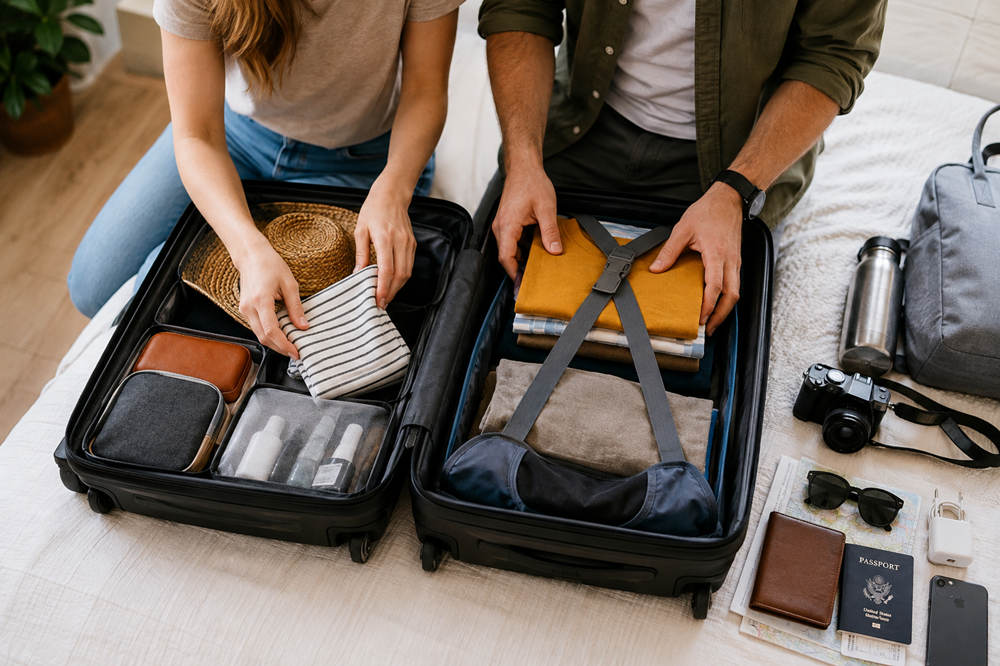
Use packing cubes or separate sections so that both travelers can find what they need without emptying every bag. Seal liquids in leak-resistant pouches, place contact information inside each suitcase, and photograph the bags before checking them.
Couples can reduce the inconvenience of one delayed suitcase by cross-packing. Place one complete outfit belonging to each partner in the other person’s checked bag. The basic overnight clothing in the cabin bag remains the first backup; cross-packing provides another layer of protection.
Check baggage limits for the exact carrier, route, fare, and cabin. Weight allowances can also be different on connecting regional flights. A portable luggage scale is particularly useful before returning with purchases.
Leave Unnecessary and Restricted Items at Home
Most overpacking comes from preparing for unlikely scenarios. Remove items that serve only one uncertain purpose, are easy to buy locally, or create customs and security complications.
Common items to reconsider include:
- Several pairs of similar shoes
- Full-size toiletries
- Expensive or sentimental jewelry
- Clothes that coordinate with only one outfit
- Incompatible electrical appliances
- Duplicate chargers and cables
- Prohibited self-defense products
- Damaged batteries
- Unverified food, plants, seeds, or animal products
Security, airline, and customs rules are separate. An item accepted at an airport checkpoint may still be restricted by the airline or destination country.
Travelers entering the United States should declare agriculture-related products, including foods, plants, seeds, and animal products, and present them for inspection. Declaring something does not automatically mean it will be confiscated, but failing to declare it can create a more serious problem.
Complete a Final 24-Hour Check
The day before departure, place the packed bags together and verify the decisions that could affect the journey.
- Confirm passport validity, visas, and entry authorizations
- Review flight terminals and ground transportation
- Check the current weather forecast
- Verify cabin and checked-bag limits
- Charge devices and download essential information
- Confirm that documents, medicines, valuables, and restricted batteries are in the correct cabin bags
- Make sure each partner has access to money and emergency contacts
- Weigh the luggage
- Remove unnecessary last-minute additions
Before leaving, check bathroom counters, electrical outlets, printers, bedside tables, coat pockets, and any place where an essential item may be charging, drying, or waiting to be packed.
Pack for Independence as Well as Convenience
A useful international travel packing list does not prepare for every imaginable problem. It protects the essentials, supports the itinerary, and keeps the luggage manageable.
Share items that genuinely save space, but make sure both partners can function independently if a wallet, phone, or suitcase is delayed. With documents, medication, clothing, and technology organized thoughtfully, you can spend less of the trip managing bags and more of it enjoying the destination together.