How Often Must You Receive a Defensive Foreign Travel Briefing?
A defensive foreign travel briefing is generally completed before covered foreign travel, not simply once every year. The exact requirement depends on the traveler’s clearance, employer, agency, program access, destination and reason for traveling.
For Department of Defense personnel with access to Sensitive Compartmented Information, the rule is clear: anticipated official or personal foreign travel must be reported, and the traveler must obtain the appropriate security briefing before departure. Other cleared employees may follow different procedures established by their agency, command, government customer or facility security officer.
How Often Must You Receive the Briefing?
The most accurate general answer is:
You must receive the required defensive foreign travel briefing before each trip covered by your organization’s security rules.
The official DoD term is “defensive travel security briefing.” Under the DoD SCI Administrative Security Manual, personnel with SCI access who plan official or unofficial foreign travel must report the trip and obtain either a defensive travel security briefing or a risk-of-capture briefing before traveling.
This does not mean every employee in every federal or contractor position follows an identical process. Some organizations provide a briefing for every international trip. Others require additional briefings only for certain countries, assignments or types of access.
Travelers should therefore contact their security office whenever a foreign trip is planned rather than assuming that an earlier briefing is still sufficient.
Is the Briefing Required Every 12 Months?
The commonly quoted 12-month requirement usually refers to general security education, not the foreign travel briefing itself.
Under 32 CFR 117.12, contractors must provide cleared employees with security education and training every 12 months. That refresher reinforces subjects covered during initial security training and informs employees about regulatory changes or concerns identified by the contractor.
A foreign travel briefing serves a different purpose. It prepares someone for the risks and reporting responsibilities associated with an actual overseas journey.
- Annual refresher training maintains general security awareness.
- A foreign travel briefing prepares the employee for a planned international trip.
A person may be current on annual training and still need a new briefing before traveling. Likewise, completing a trip-specific briefing does not replace required annual security education.
Who May Be Required to Receive One?
Formal foreign travel briefing requirements most often apply to people whose duties, knowledge or access could make them targets for intelligence collection.
Covered travelers may include:
- Personnel with SCI access
- Military members covered by command security policies
- Federal employees in sensitive positions
- Cleared defense-contractor employees
- Personnel assigned to Special Access Programs
- Employees handling classified or sensitive technical information
- People subject to additional contractual reporting requirements
These groups do not necessarily follow the same procedure. The Defense Counterintelligence and Security Agency advises cleared contractors to consult their government customers about additional requirements for personnel with SCI, SAP or other specialized access.
An employee who is uncertain about the rules should contact the facility security officer, special security officer, security manager or counterintelligence representative responsible for the employee’s organization.
Does the Requirement Apply to Personal Travel?
Personal foreign travel can still create reporting and briefing obligations. Taking annual leave or paying for the trip privately does not automatically suspend responsibilities connected with a clearance or sensitive position.
For covered individuals, three separate actions may be involved:
- Reporting the planned trip
- Receiving a security briefing
- Obtaining approval or travel clearance
These actions are not interchangeable. A traveler may be required to report a vacation without obtaining formal approval. Another traveler may need both advance reporting and a destination-specific briefing.
Under the DCSA unofficial foreign travel checklist, cleared contractor employees report planned foreign travel to their facility security officer before departure. The security officer then determines which additional actions apply, including whether a counterintelligence briefing must be coordinated for the destination.
Why a New Briefing May Be Necessary
A previous briefing may not adequately address a later journey. Security conditions, access levels and travel plans can change.
A new or supplemental briefing may be required when:
- The traveler is visiting a different country
- The destination presents an elevated intelligence or security threat
- Local political or security conditions have changed
- The employee has gained access to more sensitive information
- The trip involves a protected program or government project
- Government equipment or controlled information will be carried
- The itinerary includes countries not listed in the original report
- An agency, command or government customer requests updated preparation
The traveler should report itinerary changes promptly. Adding another destination may introduce separate security, clearance or documentation requirements.
What Does a Defensive Foreign Travel Briefing Cover?
The briefing is intended to prepare travelers for realistic threats they may encounter outside the United States. According to the CDSE Foreign Travel Brief Student Guide, an effective briefing addresses vulnerability awareness, personal safety, destination threats, assistance contacts and post-travel responsibilities.
Foreign Intelligence Targeting
Travelers may be approached because of their employer, technical knowledge, professional relationships or access to government information. Collection attempts do not always look suspicious. They may begin as casual conversation, professional networking, repeated questions or an offer of assistance.
The briefing explains how to recognize elicitation, unusual interest in work responsibilities and attempts to establish an unexplained continuing relationship.
Information and Device Security
Phones, laptops and tablets can expose contact lists, email accounts, stored documents and travel plans. An organization may restrict which devices can be carried, provide temporary equipment or prohibit access to certain systems while abroad.
Travelers may also be instructed to remove unnecessary data, install updates before leaving and report any device that is lost, searched or left outside their control.
Personal Safety and Local Conditions
Briefings may address crime, civil unrest, terrorism, surveillance, detention risks and local laws. The advice should reflect the destination and itinerary rather than rely entirely on general travel precautions.
Travelers may be told how to protect their lodging, select transportation, avoid predictable routines and respond if they are questioned by local authorities.
Emergency Contacts
A traveler should know how to reach the organization’s security office and technical-support team. Contact details for the nearest U.S. embassy or consulate may also be included.
These contacts become especially important if a passport, device, government item or sensitive document is lost or compromised.
What Should Be Completed Before Departure?
Security requirements should be addressed early, especially when a trip involves several countries or official government duties.
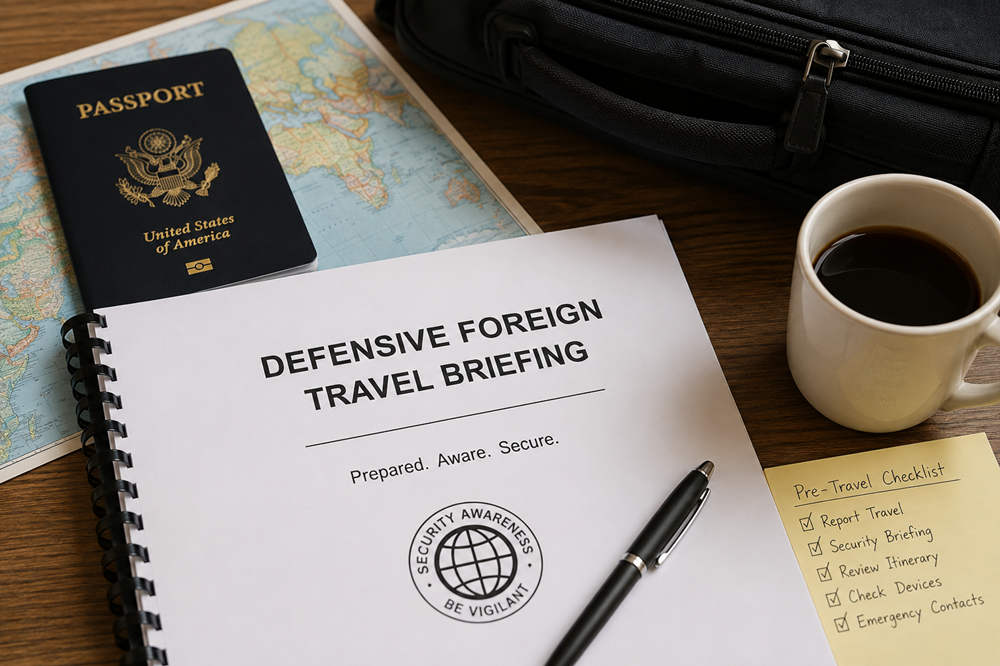
- Report the trip. Provide the destination, travel dates, purpose and requested itinerary information to the appropriate security representative.
- Confirm that recurring training is current. Complete any overdue security or counterintelligence refresher courses.
- Receive the required briefing. Review the threats and reporting procedures relevant to the trip.
- Check device restrictions. Determine which electronics and information may be carried or accessed abroad.
- Obtain necessary clearances. Official travelers may need country, theater or special-area clearance.
- Record emergency contacts. Keep organizational and consular contact information somewhere accessible.
- Review local laws. Rules governing medication, identification, photography and electronic communications can differ from U.S. law.
Official DoD travelers should also review the applicable Foreign Clearance Guide requirements and complete any required country or theater clearance process before departure.
What Must Be Reported After the Trip?
Post-travel reporting focuses on unusual events, contacts and possible security compromises that occurred during the journey.
A traveler may need to report:
- Persistent questions about work, colleagues or government activities
- Contact with a suspected foreign intelligence representative
- Unexpected interaction with foreign government officials
- Detention, arrest or unusual questioning
- A significant legal or customs incident
- A lost, stolen, searched or tampered device
- Suspected surveillance or access to a hotel room or luggage
- Unplanned changes to the reported itinerary
DCSA guidance requires cleared contractor employees to notify their facility security officer about certain travel anomalies, unplanned foreign contacts, legal incidents and itinerary deviations. A post-travel counterintelligence debrief may be arranged when an incident has security significance.
Travelers should report concerns even when they are unsure whether an actual intelligence effort occurred. The security office can evaluate the event and determine whether further action is necessary.
Traveling With a Spouse or Partner
A spouse or partner does not automatically need a formal briefing simply because they are accompanying a covered employee. Separate requirements may apply when both travelers hold clearances or work in sensitive positions.
Before departure, the couple should agree not to discuss protected work in airports, hotels, restaurants, taxis or other public places. The partner should also know whom to contact if the employee is detained, separated from the group or unable to communicate.
Both travelers should be careful about sharing a detailed itinerary on social media. Posts can unintentionally reveal dates, locations, professional relationships or the purpose of the journey.
Final Takeaway
A defensive foreign travel briefing does not have a universal once-a-year schedule. For DoD personnel with SCI access, the required briefing must be obtained before covered official or personal foreign travel. Other agencies and cleared employers may apply different procedures based on the traveler’s destination, duties and access.
The separate 12-month rule applies to recurring security education for cleared contractor employees. When planning an international trip, contact the appropriate security office early to confirm which reporting, briefing, approval and post-travel requirements apply.