
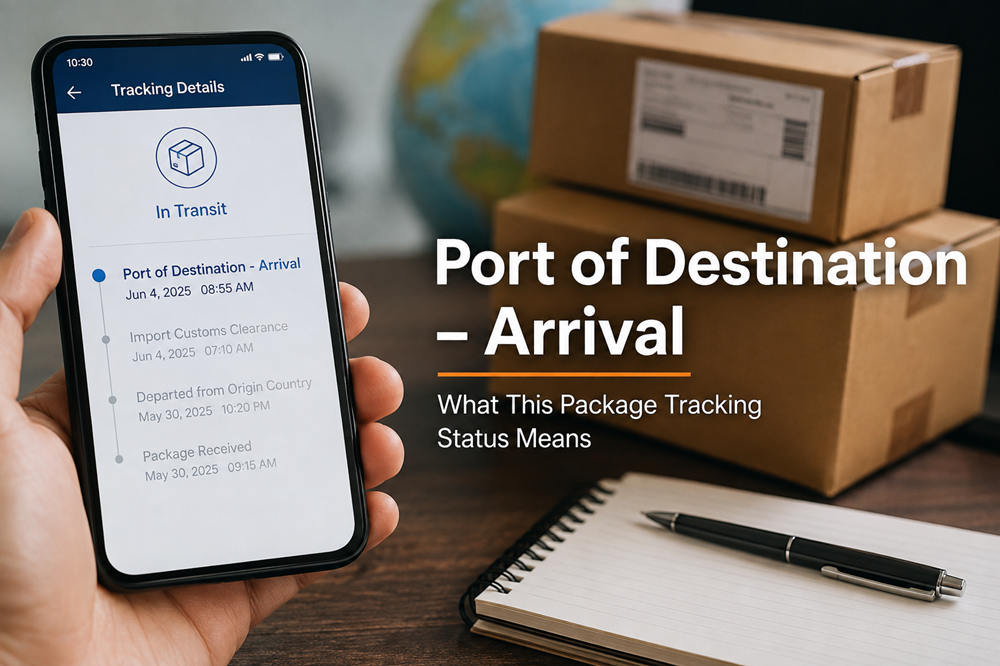
Port of Destination – Arrival: What This Package Tracking Status Means
If your tracking says “Port of Destination – Arrival,” your international package has reached an important point in its journey. However, it usually is not ready for delivery yet. Customs processing, transfer to a local carrier, domestic sorting, and last-mile transportation may still follow.
The phrase appears in cross-border shipping systems, including Yanwen tracking. Here is what it means, what normally happens next, and what to do if the package seems stuck.
What Does “Port of Destination – Arrival” Mean?
“Port of Destination – Arrival” means the shipment has reached the destination point for the international transportation stage. Yanwen, a carrier commonly used for cross-border e-commerce shipments, officially uses this exact wording for one of its tracking events.
It is best to think of the status as the end of a major international transportation leg rather than the end of the entire delivery journey.
The word “port” also should not be used to determine the parcel’s exact location or method of transportation. Carrier terminology describes logistics events, and the tracking message alone may not tell you which airport, cargo facility, logistics terminal, or other gateway is handling the shipment.
Is the Package Already in the Destination Country?
The status generally indicates that the shipment has reached the destination side of its international route. For example, a parcel being transported from China to the United States may receive this update when its international transportation reaches the U.S. destination stage.
That does not mean the parcel is near your home. It may still be at an international gateway or processing facility hundreds or even thousands of miles from the delivery address.
Tracking information can also take time to appear. Different carriers and tracking platforms exchange data at different intervals, so the customer-facing update may not perfectly match the parcel’s location at that exact moment.
Does “Port of Destination – Arrival” Mean Customs Has Cleared the Package?
No. Destination arrival and customs clearance are different tracking events.
After an international shipment reaches its destination country or region, it may still need import processing. Depending on the country and shipment, that can involve documentation checks, customs inspection, taxes or duties, or other import requirements.
Yanwen’s tracking system illustrates the distinction clearly. It has separate events for destination arrival and for stages such as import customs clearance in process and international shipment release after import clearance.
If your only update says “Port of Destination – Arrival,” do not assume customs has already released the parcel. Look for a later message referring to customs clearance, import release, or onward transportation.
What Happens After Port of Destination Arrival?
The exact route varies by country and carrier, but the remaining journey commonly includes several steps:
- Arrival at the destination-side international gateway
- Import or customs processing where required
- Release for onward transportation
- Movement to a destination sorting or logistics hub
- Handoff to a postal service or other last-mile carrier
- Regional and local sorting
- Out-for-delivery processing
- Final delivery
Not every parcel will display a separate tracking message for every step. Some inexpensive international shipping services provide relatively sparse tracking, while others show numerous individual scans.
For U.S.-bound international mail, U.S. Customs and Border Protection explains that incoming mail reaches a USPS sorting facility and is then presented to CBP for examination and assessment of applicable duties or taxes before proceeding through the postal system.
How Long Does Delivery Take After Port of Destination Arrival?
There is no dependable fixed number of days between this status and delivery.
A parcel can move through the remaining stages quickly, but customs processing, carrier handoffs, weekends, holidays, transportation disruptions, and local delivery workloads can extend the timeline.
Other factors include:
- The shipping service originally purchased
- The destination country and delivery region
- Whether customs needs additional information
- Whether duties or taxes need to be handled
- The distance from the international gateway to the recipient
- How quickly the destination carrier receives the shipment
- Weather or transportation delays
For a realistic delivery expectation, give more weight to the carrier’s latest estimated delivery window than to a general estimate based solely on the port-arrival status.
What Tracking Status Usually Comes Next?
The next message depends on the carrier and route. You might see an update related to:
- Customs clearance in progress
- Import clearance completed
- Arrival at an international or destination hub
- Pickup by the destination carrier
- Transfer to the local delivery company
- Arrival at a regional sorting facility
- Movement through the domestic network
- Out for delivery
The wording does not need to match these examples exactly. Carriers use different terminology, and tracking aggregators sometimes simplify or translate the original scans.
What you want to see is continued progress from international transportation toward customs release, destination-country transportation, and eventually local delivery.
How to Find the Last-Mile Carrier
Once the international leg is ending, identifying the last-mile carrier can give you much better tracking information.
The company that transported your order internationally is not necessarily the company that will deliver it to your door. Cross-border logistics companies frequently transfer parcels to national postal services or local couriers for final delivery.
Open the detailed version of your tracking history and look for information such as:
- Destination carrier
- Last-mile carrier
- Local delivery partner
- Secondary tracking number
- Destination-country tracking number
Yanwen’s tracking system, for example, can provide information identifying the destination-country carrier and last-mile tracking number for supported shipments.
If you find another tracking number, enter it directly on the local carrier’s official website. Once the parcel has been handed over, that carrier may show more detailed domestic scans than the original seller or international tracking platform.
In the United States, a status such as “USPS Awaiting Item” means you should pay attention to who actually has possession of the package. USPS distinguishes shipping-partner events from scans showing that USPS itself has received the item.
Why Is Tracking Stuck on “Port of Destination – Arrival”?
A period without new tracking information does not automatically mean the parcel is lost.
International shipments may need to be unloaded, processed, cleared, sorted, or transferred before another visible scan is generated. There may also be a delay between one carrier completing its portion of the journey and the next carrier registering the parcel in its system.
Other common reasons for an apparent pause include:
- Customs processing
- Weekend or holiday schedules
- Waiting for a carrier handoff
- Delayed electronic tracking updates
- Limited tracking on economical shipping services
- High parcel volumes at a destination facility
A short gap in tracking is therefore usually more useful to interpret alongside the expected delivery window than on its own.
When Should You Contact the Seller or Carrier?
You generally do not need to contact someone immediately after seeing a destination-arrival scan. Start by checking the detailed tracking page for another carrier or tracking number and allow time for the next processing event.
Consider taking action when:
- The estimated delivery window has passed
- Tracking reports a customs or delivery exception
- The carrier asks you to provide information or payment
- The parcel has shown no meaningful movement for an unusually long time
- The local carrier says it never received the shipment
If there is a last-mile carrier, check its official tracking system first. Otherwise, contact the seller or original shipping company and ask whether it can see additional shipment information.
For U.S. deliveries, USPS recommends checking available tracking information and, where appropriate, contacting the shipper when a parcel appears delayed. If a USPS shipment ultimately meets the requirements for a missing-mail search, you can use the USPS Missing Mail process.
What If You Need the Package Before a Trip?
Destination arrival can sound especially reassuring when you are waiting for something needed for an upcoming honeymoon, destination wedding, anniversary getaway, or vacation. But it is not a guarantee that the item will arrive before you leave.
Maybe you ordered honeymoon clothes, a travel adapter, luggage accessories, wedding items, camera equipment, or a special gift. If the item is important to the trip and your departure date is getting close, decide based on how difficult it would be to travel without it rather than on the optimistic sound of the tracking message.
For something easily replaced locally, setting a deadline for buying an alternative can prevent a last-minute scramble. Less important purchases can usually wait as long as the carrier’s delivery estimate still works with your plans.
Most importantly, avoid packing plans that depend entirely on an international parcel that has not yet entered the final local delivery stage.