Destination Wedding Save the Date: When to Send and Wording Examples
A destination wedding save-the-date gives guests something especially valuable: time. Unlike a local wedding, attending may require flights, hotel reservations, vacation days, childcare, and a larger travel budget.
A useful rule is to send destination wedding save-the-dates about 8 to 12 months before the wedding, with 9 to 12 months working well for many couples. For an international, remote, expensive, or peak-season destination, giving more than a year’s notice can be reasonable once the date and location are firmly established.
Destination Wedding Save-the-Date at a Glance
| Question | Quick Answer |
|---|---|
| When should you send it? | About 8–12 months before the wedding |
| What about a major international trip? | More than 12 months can be helpful |
| What should it include? | Names, date, destination, wedding website, and invitation-to-follow wording |
| Do you need the exact venue? | Not necessarily, as long as guests know the destination |
| Should guests RSVP now? | Usually not formally; the invitation handles the official RSVP |
| Where should travel details go? | On the wedding website |
When Should You Send Destination Wedding Save-the-Dates?
Destination weddings generally require more advance notice than local celebrations. Current save-the-date guidance from Zola recommends about 8 to 12 months for a destination wedding, while other wedding-planning guidance commonly places the ideal range around 9 to 12 months.
You may want to send yours even earlier if:
- Most guests will need international flights.
- The destination takes several connections to reach.
- The wedding falls during a holiday or busy travel season.
- Hotels or vacation rentals are limited.
- The trip is likely to require substantial budgeting.
- Many guests will need several days away from work.
- Guests may need new passports, visas, or other travel documents.
The important distinction is between early and premature. Do not send the notice while your date, destination, or venue arrangements are still likely to change. Guests may begin researching airfare and accommodations as soon as the card arrives.
What to Include on a Destination Wedding Save-the-Date
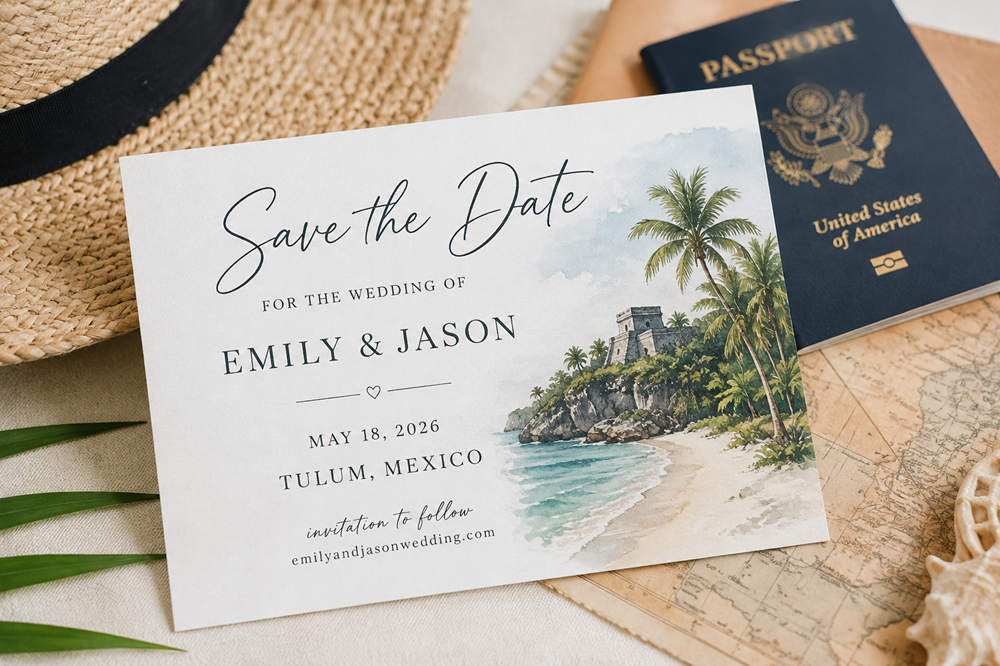
The card should answer four basic questions: who, when, where, and where guests can find updates.
Include:
- Your names
- The wedding date or date range
- The destination — usually a city and state, island, region, or city and country
- Your wedding website
- A phrase such as “Invitation to follow”
The exact venue does not always need to appear. If you know you are marrying in Florence but are still finalizing details at a particular property, “Florence, Italy” gives guests enough information to understand the trip.
For a celebration with guest events spread across several days, list the relevant date range. Someone considering a flight needs to know that the wedding weekend extends from Friday through Sunday rather than assuming only Saturday matters.
What Should Stay Off the Save-the-Date?
A save-the-date is advance notice, not a compressed version of the invitation or wedding website. Keeping it simple also prevents outdated information from being permanently printed months before the trip.
Usually, you can leave off:
- Exact ceremony and reception times
- A full weekend itinerary
- Detailed hotel-booking instructions
- Shuttle schedules
- Individual event dress codes
- Meal selections
- Registry information
- Unconfirmed excursions or activities
Details that may change belong online, where you can update them without asking guests to keep track of corrections.
Destination Wedding Save-the-Date Wording Examples
Destination wording does not need travel puns or elaborate phrases. Clear wording is usually more useful, especially when guests are trying to identify the destination and dates at a glance.
Simple and Classic
Save the Date
Olivia Bennett & Daniel Reyes
June 12, 2027
Charleston, South Carolina
ourweddingsite.com
Invitation to follow
Formal Destination Wedding
Please save the date
for the wedding of
Amelia Carter and James Sullivan
September 18, 2027
Florence, Italy
Additional details at ourweddingsite.com
Formal invitation to follow
Casual Destination Wedding
We’re getting married!
Maya & Chris
May 8, 2027
San Juan, Puerto Rico
Save the date
Travel details: ourweddingsite.com
International Wedding
Please save the date
Sophie & Alex
October 2, 2027
Lisbon, Portugal
We hope you can join us
Travel information: ourweddingsite.com
Invitation to follow
Beach Destination Wedding
Save the date for the wedding of
Emma & Noah
February 20, 2027
Grace Bay, Turks and Caicos
ourweddingsite.com
Invitation to follow
Mountain Wedding
Lauren & Michael are getting married
August 14, 2027
Aspen, Colorado
Please save the date
Travel details: ourweddingsite.com
Weekend-Long Celebration
Save the Weekend
Avery & Jordan
April 9–11, 2027
New Orleans, Louisiana
Weekend details: ourweddingsite.com
Invitation to follow
Small Destination Wedding
Please save the date
for the wedding of
Taylor & Morgan
November 6, 2027
Maui, Hawaii
We would love to celebrate with you
ourweddingsite.com
These examples can be adjusted to match the formality of the event. What matters most is that the names, destination, and date remain unmistakable.
Should You Say “Save the Date” or “Save the Weekend”?
Use “Save the Date” when the wedding day is the main commitment you are asking guests to make.
“Save the Weekend” makes more sense when the same guests are invited to several planned events, such as a Friday welcome gathering, Saturday ceremony and reception, and Sunday brunch. Another simple option is to show the complete date range without using the phrase at all.
For example:
October 15–17, 2027
Please save the dates for our wedding weekend in Barcelona.
If some weekend events are optional, the website can make that clear. And if an event is limited to the wedding party or immediate family, do not present it on the general save-the-date as though every recipient is invited.
Put the Travel Information on Your Wedding Website
For a destination celebration, the website should become the main source of practical information. That allows the save-the-date to remain uncluttered while guests still have somewhere to begin planning.
Your site can gradually include:
- Recommended airport or transportation hub
- Hotel blocks and booking deadlines
- Alternative areas to stay
- Distance between accommodations and wedding events
- Ground transportation plans
- The general wedding-weekend schedule
- Weather and packing considerations
- Accessibility information when relevant
- Passport and entry information for international destinations
A wedding website does not have to be fully complete when save-the-dates go out. It should at least confirm the destination and dates and contain whatever information guests genuinely need to make early travel decisions.
For an international wedding, avoid presenting visa or passport rules as permanent facts. U.S. passport holders can check the U.S. Department of State’s international travel guidance for current entry, exit, visa, and passport-validity information. Guests traveling on other passports should check the requirements that apply to their own nationality and destination.
Do Guests RSVP to a Destination Wedding Save-the-Date?
Normally, no. The formal invitation is the appropriate place for the official RSVP request. Minted’s current save-the-date etiquette guidance likewise recommends leaving the RSVP request for the invitation.
Destination weddings can create one exception worth understanding. If you genuinely need an early estimate for accommodations or transportation, you can use your wedding website to ask guests for a nonbinding indication of whether they currently expect to attend.
Make the distinction clear. An early planning question is not the final RSVP, and someone’s circumstances may change before invitations arrive.
Paper or Digital Save-the-Dates?
Both formats can work for a destination wedding.
Printed cards feel traditional and give guests something tangible to keep. They may suit a more formal wedding particularly well.
Digital save-the-dates are faster to deliver and make it easy for guests to click directly through to the wedding website. That can be particularly convenient when your guest list is spread across different countries.
A hybrid approach is also reasonable. You might mail cards to some households while sending digital notices to guests for whom international postage or delivery would be inconvenient.
Whichever format you choose, everyone should receive the same essential dates and destination information.
Who Should Receive a Save-the-Date?
Send a save-the-date only to someone you intend to invite. For a destination wedding, that principle is especially important because guests may make financial and scheduling decisions soon after receiving it.
If your guest list is still uncertain because of venue capacity or budget, wait before sending notices to people whose invitations are not confirmed.
The addressing should also give guests a reasonable idea of who is included. Where possible, clarify invited partners, children, and known plus-ones rather than leaving households to guess.
This can affect travel planning. A guest arranging a solo trip needs different flights, accommodations, and costs from a family of four.
Common Destination Save-the-Date Mistakes
Sending It Before Plans Are Firm
Confirm the wedding date and destination before asking anyone to reserve travel dates.
Forgetting the Year
Always print the year, especially if you are giving more than 12 months’ notice.
Using a Destination That Is Too Broad
“Italy” or “Mexico” may not tell guests enough. Include the city, island, resort area, or region when you can.
Printing Unconfirmed Logistics
Do not put shuttle departure times, tentative excursions, or other evolving details on stationery months before they are final.
Overloading the Design
Your names, date, and location should not disappear inside paragraphs of hotel and transportation instructions.
Linking to an Empty Website
Test the URL and any QR code before sending. The page should at least contain the dates, destination, and available travel basics.
Quick Checklist Before You Send
- Date and destination are confirmed.
- The correct year appears clearly.
- Names and place names are spelled correctly.
- The recipient list contains only confirmed guests.
- Household and plus-one wording has been checked.
- The wedding website is live.
- The URL and QR code work.
- The correct date range appears for a multi-day celebration.
- Unconfirmed travel details have been left online rather than printed.
- The final design has been proofread before printing or sending.
Give Guests Enough Information to Start Planning
A destination wedding save-the-date does not need to plan the trip for your guests. It simply needs to give them enough notice and certainty to begin planning it themselves.
Once your date and destination are firm, share them early, keep the card simple, and direct guests to a wedding website for evolving travel details. That gives everyone a useful head start without locking you into information that may still change.