Erie County Travel Ban: What Couples Visiting Buffalo Need to Know
An Erie County travel ban can quickly affect a winter trip to Buffalo, from airport transportation and hotel check-ins to restaurant reservations and the drive home. Because restrictions can change during a storm, always verify the latest official notice before getting on the road.
This guide refers to Erie County, New York, which includes Buffalo and many surrounding communities.
Is an Erie County Travel Ban Active Now?
Travel bans and advisories are temporary. A news report or social media post from earlier in the day may no longer reflect the current situation, so check the time, effective date, and exact area named in every notice.
Use the following official sources to check current conditions:
- Erie County winter guidance for official definitions and safety information
- Erie County DPW Road Status Viewer for restrictions, closures, and incidents on county roads
- 511NY for state highways, traffic incidents, cameras, closures, and winter road conditions
- BUFFALERT for City of Buffalo road closures, snow emergencies, parking restrictions, and public-safety notices
- National Weather Service Buffalo for forecasts, warnings, radar, and snowfall information
- Buffalo Niagara International Airport flight status for current arrivals and departures
No single map covers every road in Erie County. The county viewer focuses on county roads, while 511NY is useful for state highways and major routes. Municipal announcements may provide additional information about streets within Buffalo or another town or village.
A restriction may cover the entire county, one municipality, or a limited group of roads. Always confirm where it applies rather than assuming conditions are the same throughout the Buffalo area.
Travel Advisory vs. Travel Ban
Erie County uses the terms travel advisory and travel ban for different levels of restriction.
Travel Advisory
A travel advisory means that travel is unsafe and should be limited to necessary or emergency trips. Driving may not be completely prohibited, but visitors should postpone sightseeing, shopping, dining, and other optional journeys.
Travel Ban
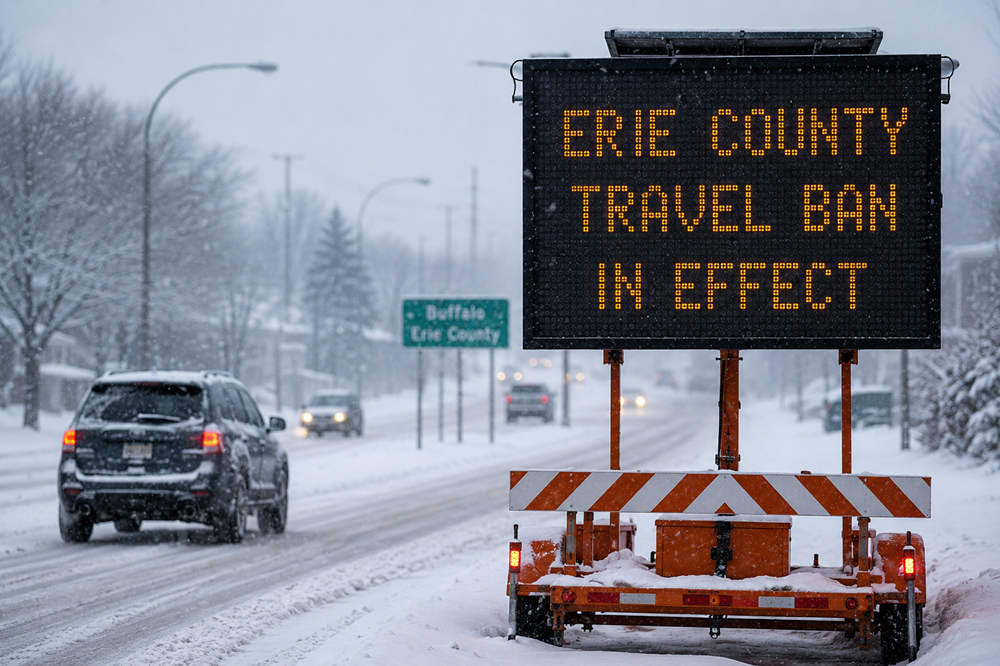
A travel ban is a temporary law prohibiting driving because roads are considered too dangerous. Keeping unnecessary vehicles off the road also gives snowplows and emergency responders more space to operate.
Visitors should not assume that a flight, hotel booking, restaurant reservation, or event ticket qualifies as essential travel.
Essential workers must follow the instructions issued for that particular emergency and carry appropriate documentation from their employer. Erie County’s essential-travel guidance notes that essential categories may change depending on the incident and that travel remains subject to public-safety decisions.
Weather Warnings and Travel Restrictions Are Different
The National Weather Service issues watches, advisories, and warnings describing expected weather. Erie County and local governments decide whether road travel should be restricted.
A winter storm warning does not automatically mean that a travel ban is active. Likewise, the absence of a countywide ban does not guarantee that every road is safe.
Before leaving, check three things:
- The weather forecast for the complete route
- The current county or municipal travel restriction
- Road closures and conditions between your starting point and destination
This is especially important around Buffalo because lake-effect snow can be highly localized. One community may have light snowfall while another experiences rapid accumulation, blowing snow, or very poor visibility.
How a Travel Restriction Can Affect Your Buffalo Trip
A travel ban can disrupt more than driving. It may also affect lodging, flights, rental cars, restaurants, attractions, and scheduled events.
Hotels
Contact your hotel before attempting to check in, check out, or move to another property. Staff may be able to extend your stay, adjust the checkout time, or explain access conditions near the building.
Do not leave safe lodging simply because the original reservation is ending. Speak with the front desk before making other arrangements.
Buffalo Niagara International Airport
Flight operations and road conditions are separate. A flight may still appear as scheduled even when reaching the terminal is difficult or prohibited.
Check the airport’s official flight-status page and confirm the flight directly with the airline. Then review road restrictions before arranging a taxi, rideshare, shuttle, or rental car.
Rental Cars
A rental-car return deadline does not override an official travel ban. Contact the rental company, explain the situation, and ask how it handles weather-related extensions or delayed returns.
Keep records of calls, messages, receipts, and any instructions you receive.
Restaurants, Attractions, and Events
A reservation may remain active in an app even when a business has closed early or cannot operate normally. Contact the venue directly before leaving your accommodation.
Handle prepaid activities only after lodging and transportation have been secured. A missed dinner or attraction is less urgent than finding a safe place to remain.
Driving Into or Out of Erie County
Do not judge the entire journey by conditions near your starting point. Roads may become significantly worse as you approach Buffalo or enter a lake-effect snowband.
Review the full route on 511NY, including state highways and New York State Thruway connections. Confirm that your destination is open and accessible before departing.
What to Do During an Erie County Travel Ban
If a travel ban begins while you are already in the area, stop optional driving and remain in a safe indoor location.
Contact your hotel first if the restriction could affect your stay. Next, deal with flights or trains, rental cars, and ticketed events in that order.
Couples can divide the practical work. One person can monitor Erie County and weather updates while the other contacts the hotel, airline, rental company, and reserved venues.
Keep phones and portable batteries charged. Ask your accommodation about available food, parking restrictions, power-outage procedures, and any changes to building access.
Do not drive around to inspect conditions or take snow photographs. Streets visible from a hotel window may not reflect conditions elsewhere in the county.
If You Become Stranded in a Vehicle
Avoid beginning a journey during a ban, even if the vehicle has all-wheel drive, four-wheel drive, or winter tires. Deep snow, drifting, poor visibility, abandoned vehicles, and blocked roads can stop well-equipped cars.
Erie County advises anyone trapped on the road to call 911. Share your location as accurately as possible, including the road name, direction of travel, nearest exit, mile marker, or visible landmark.
While waiting for assistance:
- Stay with the vehicle unless remaining there creates a greater danger
- Put on additional warm layers and use available blankets
- Use hazard lights when appropriate
- Keep snow away from the exhaust pipe
- Run the engine only as needed for warmth
- Avoid exhausting yourself by attempting to push or dig out the vehicle alone
Emergency response may take longer during a widespread storm, which is one reason to remain off restricted roads.
Preparing for a Winter Trip to Buffalo
A little flexibility can prevent a weather delay from becoming a larger travel problem.
Leave Space in the Itinerary
Avoid placing an important flight, long-distance drive, or nonrefundable event immediately after hotel checkout. A flexible departure day can be valuable when snow affects roads or flight schedules.
Review Cancellation Policies
Before booking, check the weather-related cancellation and change policies for hotels, airlines, trains, rental cars, tours, events, and travel insurance.
Bad weather does not always guarantee a refund. Eligibility may depend on whether a provider cancels the service or whether the disruption meets the terms of an insurance policy.
Sign Up for Local Alerts
BUFFALERT sends City of Buffalo notices about severe weather, road closures, snow emergencies, parking restrictions, service changes, and public-safety issues.
The upgraded ReadyErie preparedness app provides Erie County alerts, weather updates, emergency-planning tools, supply checklists, and options for sharing your status with selected contacts.
Carry Basic Winter Supplies
Keep a small winter kit in your personal or rental vehicle. Useful supplies include:
- Warm coats, hats, gloves, and boots
- Blankets
- Water and nonperishable snacks
- A snow brush and ice scraper
- A flashlight
- A portable phone charger
- A small shovel
- First-aid supplies
- Necessary medications
- Jumper cables
- A reflective warning device
Keep a comfortable amount of fuel in the vehicle. These supplies are precautions for an unexpected emergency, not permission to drive during a ban.
What to Do After the Ban Is Lifted
The end of a travel ban does not mean that every road, parking lot, or business has immediately returned to normal.
Main roads may reopen while residential streets, hotel entrances, and side roads remain difficult. Snowbanks can narrow lanes, hide signs, and reduce visibility at intersections.
Before leaving:
- Check the complete route again
- Confirm that the destination has reopened
- Look for continuing municipal advisories or road closures
- Remove all snow and ice from the vehicle
- Allow additional travel time
- Increase the distance between your vehicle and others
- Give plows and emergency vehicles plenty of space
Continue monitoring the forecast. Lake-effect snowbands can move, weaken, or redevelop after an earlier restriction has ended.
Handling a Buffalo Winter Delay Together
An Erie County travel ban can interrupt a carefully planned couples trip, but the safest response is straightforward: remain in secure lodging, stop unnecessary driving, follow official updates, and rearrange reservations after immediate needs are covered.
Check both the legal travel status and the weather before every journey. Conditions can vary significantly across Erie County, and a road that appears manageable in one place may be dangerous only a few miles away.
A delayed activity or an additional hotel night can be frustrating. Attempting to drive through a restricted area can turn that inconvenience into a serious emergency.