Book Now, Pay Later Hotels: Pay at Check-In or in Installments
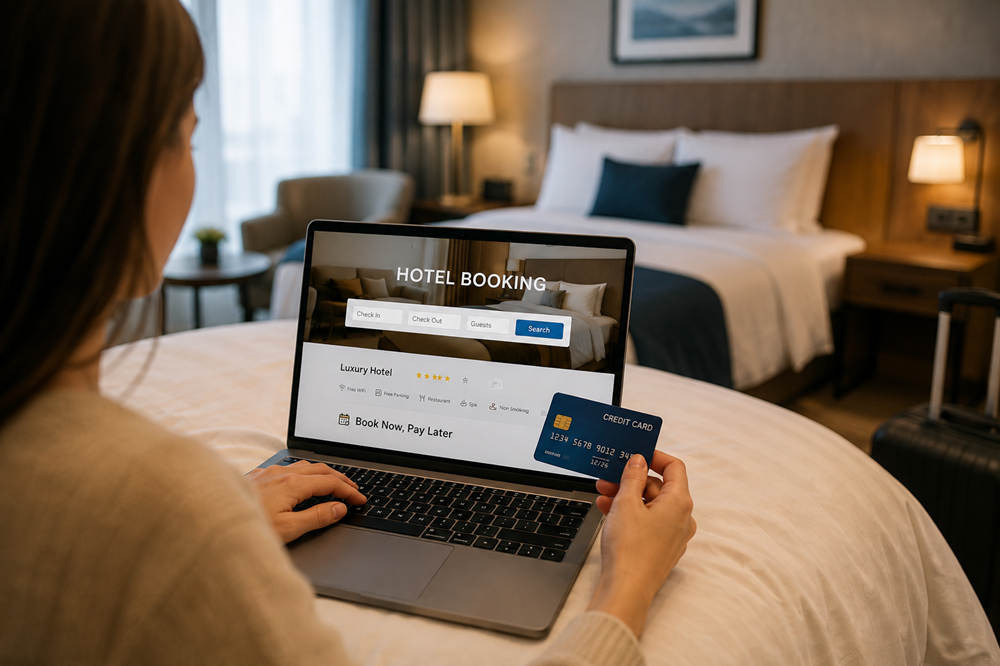
Booking a hotel does not always mean paying for the entire stay the day you reserve it. Depending on the property and rate, you may be able to reserve the room and pay at the hotel, or use an installment service that spreads the cost across several payments.
Those options can be useful for couples managing flights, accommodations, activities, and other travel expenses at the same time. But “pay later” can mean very different things, so the payment terms deserve a close look before you book.
What Does “Book Now, Pay Later” Mean for Hotels?
Hotel booking sites generally use “pay later” to describe one of two arrangements: paying the property around the time of your stay or financing the purchase through a buy now, pay later provider.
Reserve now and pay at the hotel
With a pay-at-property rate, you secure the reservation in advance while delaying the room payment until later, typically around check-in or checkout. You may still need to enter a credit or debit card when booking to guarantee the reservation.
This is the most straightforward option for travelers who simply do not want the full hotel cost charged months before the trip.
Book now and pay in installments
An installment plan is a form of financing. Rather than owing the hotel the entire amount at arrival, you agree to repay a payment provider according to a schedule.
Providers such as Affirm and PayPal Pay Later offer installment options for eligible travel purchases. The exact payment schedule, approval requirements, purchase limits, and interest terms depend on the provider and plan.
Some installment arrangements require a payment at the time of booking, so “buy now, pay later” should not automatically be interpreted as “pay nothing today.”
Pay later does not automatically mean free cancellation
Payment timing and cancellation flexibility are separate conditions. A hotel may allow you to pay at the property but still charge a penalty if you cancel after a specified deadline.
Always read both the payment policy and cancellation policy attached to the individual room rate.
Where Can You Find Book Now, Pay Later Hotels?
It is usually better to search for an eligible rate than for a hotel brand that supposedly always allows delayed payment. Hotels can offer several rates for the same room, each with different payment conditions.
Expedia
Expedia’s Reserve now, pay later option helps travelers find eligible stays where payment can be delayed until the property. When comparing rooms, look for wording such as “Pay at property” and read the rate details before confirming.
Booking.com
On Booking.com, payment timing depends on the property and reservation. Some bookings are paid around check-in or checkout, while others require partial or full prepayment. The booking confirmation should state who collects the money and when.
Hotels.com
Hotels.com offers both Pay Now and Pay Later options on eligible accommodations. With Pay Later, the travel provider typically collects payment around the stay or according to the terms displayed during booking.
Eligible U.S. travelers may also encounter Affirm installment plans. Expedia Group expanded its partnership with Affirm in 2026 to cover eligible lodging and package purchases across Expedia, Hotels.com, and Vrbo in the United States.
Booking directly with the hotel
Hotel websites may offer flexible rates alongside advance-purchase rates. The difference can be significant: an advance-purchase rate may be charged immediately, while a flexible rate can postpone payment until the stay.
Do not assume the direct rate is automatically prepaid or pay later. Open the payment conditions for the exact room you want before choosing it.
Pay at the Hotel vs. BNPL Installments
| Feature | Pay at Property | BNPL / Installments |
|---|---|---|
| When you pay | Usually around check-in or checkout | According to a scheduled series of payments |
| Financing involved | No | Yes |
| Approval required | Usually no financing approval | Usually subject to eligibility or approval |
| Interest possible | No financing interest | Depends on the provider and plan |
| Best suited to | Delaying the hotel bill until the trip | Spreading a larger cost over time |
Neither option is automatically better. The right choice depends on whether you mainly want to delay the charge or actually divide the cost into smaller payments.
How to Book a Hotel Now and Pay Later
- Search for your destination and travel dates. Start with hotels that suit your itinerary rather than choosing solely by payment method.
- Look for a pay-later option. Wording may include “Reserve now, pay later,” “Pay later,” “Pay at property,” or “No prepayment.”
- Open the exact room rate. Different rates at the same hotel can have different payment rules.
- Check what is due today. Confirm whether the booking requires nothing upfront, a deposit, a first installment, or another amount.
- Read the cancellation conditions. Note the deadline and any penalty that applies afterward.
- Check the total price. Look for taxes, resort fees, destination fees, and other mandatory charges.
- Save the confirmation. Keep a copy showing the payment and cancellation terms you agreed to.
What You May Still Have to Pay at Check-In
A reservation with little or no upfront payment can still require access to additional money when you arrive.
Depending on the property, check-in costs can include:
- The remaining room balance
- Taxes collected locally
- Resort or destination fees
- Parking charges
- A security or incidental hold
An incidental hold is a temporary authorization used to cover possible expenses such as room service, minibar purchases, parking, or other charges made during the stay.
Hilton’s payment guidance, for example, explains that a hotel may place a hold on the guest’s card for estimated incidentals at check-in. Marriott’s explanation of incidental holds similarly notes that an authorization can include room charges, taxes, and an incidental deposit.
If you are using a debit card, remember that the authorized amount may temporarily reduce the funds available in your bank account. How quickly unused funds return depends in part on the financial institution.
Is a Credit Card Required for a Pay-Later Hotel?
Not necessarily, but a reservation that requires no immediate payment can still require card details.
Some hotels accept both credit and debit cards, while others place restrictions on particular payment methods. Cash policies vary even more. A property may accept cash for the final bill while still requiring a card to guarantee the reservation or provide security at check-in.
This can also matter when one partner makes the reservation using the other’s card. Check whether the registered guest or cardholder needs to be present, particularly if you will arrive separately or someone else is paying for the stay.
If the property’s policy is unclear, confirming directly with the hotel before the trip can prevent problems at the front desk.
What Couples Should Check Before Choosing Pay Later
For couples sharing travel costs, payment timing can affect more than the hotel bill itself. A little coordination before booking can make the travel budget much easier to manage.
Decide who will pay at the hotel
If the room balance is due during the trip, decide whose card will be used. This is especially useful when one partner is covering accommodation while the other is paying for flights, rental cars, meals, or activities.
Plan for the incidental hold
Find out which card will have enough available credit or bank funds to handle a temporary authorization without interfering with your everyday spending money.
Keep the cancellation deadline somewhere you both can see it
If plans change, knowing the exact cancellation cutoff can be more important than knowing when the hotel payment is due.
Check what the displayed price leaves out
Parking, resort fees, destination charges, and locally collected taxes can change what you actually spend at the property.
Check the billing currency on international trips
If the hotel charges in local currency, consider how your card handles currency conversion and foreign transaction fees. The price you see while planning may not perfectly match the amount that ultimately appears on your statement.
These details become particularly important on multi-stop trips. If three hotels all collect payment during the same week, the accommodation costs can hit your travel budget much faster than expected even though none of them required payment when you originally booked.
When Paying at the Hotel Makes Sense
A traditional pay-at-property reservation can be particularly useful when you want to secure accommodations early without moving the hotel expense to the front of your trip-planning schedule.
It may suit you when:
- You are booking several months before traveling.
- Your dates are likely to work but are not completely fixed.
- You need to pay for flights or other major expenses first.
- You are planning a longer trip with multiple hotels.
- You prefer to keep more cash available before departure.
Compare the price with other available rates before deciding. A flexible or pay-later rate can sometimes cost more than a restrictive advance-purchase option, so you are effectively deciding how much the added payment flexibility is worth to you.
When an Installment Plan May Not Be the Best Choice
Installments can make a large hotel booking easier to divide across a budget, but it is important to look beyond the size of each individual payment.
Affirm, for example, currently offers qualifying plans with rates ranging from 0% to 36% APR, depending on eligibility and the purchase. Some eligible Expedia Group customers can receive 0% APR offers, but not every shopper or booking receives the same terms.
PayPal’s Pay in 4 is structured differently: the first payment is due when the purchase is made, followed by three later payments. PayPal also offers longer Pay Monthly arrangements for eligible purchases, which can involve interest.
The bigger question is what the entire repayment schedule does to your budget. The Consumer Financial Protection Bureau’s BNPL market research found that both the average number of loans taken by users and their average annual borrowing per lender increased from 2022 to 2023.
Before financing a hotel, consider the total amount you will repay and whether payments will continue long after the trip ends. For couples, it also helps to look at all existing installment obligations together rather than treating each purchase as a separate monthly expense.
A Quick Checklist Before You Confirm
- How much is due today?
- When will the remaining balance be charged?
- Who collects the payment: the booking site, financing provider, or hotel?
- What is the cancellation deadline?
- What deposit or incidental hold might be required?
- Which taxes and mandatory fees are still due?
- If using installments, what is the APR and total repayment amount?
Save the booking confirmation after you reserve. For a trip several months away, having the original payment terms available is much safer than trying to remember exactly what “pay later” meant when you booked.
Final Thoughts
Book now, pay later hotels can give couples useful flexibility, but the best option depends on what you are trying to accomplish. If you simply want to postpone the hotel charge, look for a pay-at-property rate. If you want to divide the cost over time, compare the terms of an installment plan carefully.
Most importantly, judge the individual room rate rather than the “pay later” label alone. The amount due today, cancellation deadline, fees, check-in requirements, and total repayment cost will tell you whether the reservation actually fits your trip budget.