The Grim Adventures of Billy & Mandy: Why the Cartoon Still Stands Out
A relentlessly cheerful kid, a permanently unimpressed girl, and the Grim Reaper make an unlikely friendship group. That mismatch became the foundation of The Grim Adventures of Billy & Mandy, one of Cartoon Network’s stranger supernatural comedies.
Created by Maxwell Atoms, Billy and Mandy first reached television as part of Grim & Evil in 2001. Their adventures later became a separate half-hour series in June 2003. What followed was a mix of suburban childhood, horror parody, mythology, monsters, and absurd comedy built around three characters who approached almost everything differently.
What Is The Grim Adventures of Billy & Mandy?
The Grim Adventures of Billy & Mandy follows two children who encounter the Grim Reaper and challenge him to an otherworldly limbo contest. When Billy and Mandy win, Grim is forced to become their best friend.
The official Warner Bros. description captures the show’s basic formula: Billy is carefree, Mandy is cynical and deadpan, and their new supernatural companion becomes involved in the ordinary challenges of school and family as well as visits from the spirit world.
That contrast between normal childhood and supernatural chaos gives the series much of its identity. An episode can begin with a familiar problem—school, a pet, boredom, a neighborhood dispute—and end with monsters, curses, strange dimensions, or a badly handled piece of Grim’s magic.
Meet Billy, Mandy, and Grim
The show does not need an elaborate premise once its three central personalities are together. Each reacts so differently to the same situation that conflict develops almost automatically.
Billy
Billy approaches life with enormous enthusiasm and remarkably little caution. He is curious, impulsive, loud, and frequently unaware of how dangerous a situation has become.
His decisions create plenty of trouble because he tends to act first and understand later—if he understands at all. Even genuinely frightening creatures can become objects of fascination to him.
Mandy
Mandy operates at the other extreme. She is controlled, calculating, blunt, and difficult to intimidate.
Her almost permanent scowl is more than a visual joke. Mandy rarely responds to supernatural threats with the fear other characters expect, and she often treats powerful beings as though they are merely inconveniences standing in her way.
She is not necessarily the moral or reasonable member of the trio. Her plans can be ruthless. What separates her from Billy is that she generally understands what she is doing.
Grim
Grim should theoretically be the most powerful member of the group. He is the Grim Reaper, carries a supernatural scythe, and knows far more about monsters and the spirit world than either child.
Losing the limbo contest turns that authority upside down. Instead of remaining a distant figure of death, he becomes an unwilling participant in Billy and Mandy’s everyday lives. His powers frequently create opportunities for adventures, but they also make him the person who has to deal with the consequences when something supernatural gets loose.
The central roles are voiced by Richard Steven Horvitz as Billy, Grey DeLisle as Mandy, and Greg Eagles as Grim.
Why Their Unlikely Friendship Makes the Show Work
The premise says Grim has to be Billy and Mandy’s best friend, but the series gradually makes the relationship more interesting than a simple supernatural contract.
Billy usually wants excitement. Mandy wants control. Grim often wants peace and quiet. Those goals rarely line up.
That imbalance allows the series to produce comedy without constantly inventing new character motivations. If Grim possesses something dangerous, Billy is likely to misuse it. If a supernatural creature expects to frighten Mandy, Mandy may become the more intimidating person in the room. Grim then finds himself trying to repair a problem he never wanted to be involved in.
Over time, the trio starts to feel less like strangers forced together by a wager and more like a dysfunctional friendship with established habits and expectations.
Atoms himself emphasized this relationship when discussing the show’s durability with Animation World Network. Despite all the monsters and supernatural comedy around them, he described the series at its core as being about three friends.
That character foundation helps explain why the premise could support so many different stories. The supernatural setting could change constantly while the central relationship remained recognizable.
The Dark Humor That Set Billy & Mandy Apart
A children’s cartoon starring the Grim Reaper was always going to have an unusual relationship with horror.
The series routinely uses skeletons, demons, curses, monsters, haunted objects, the Underworld, transformations, ancient legends, and other imagery normally associated with darker stories. Instead of treating those elements with sustained seriousness, however, it places them beside slapstick, gross-out jokes, childish arguments, and ridiculous misunderstandings.
Much of the humor comes from breaking the expected mood.
A supernatural visitor may arrive with dramatic intentions only to encounter Billy, who misunderstands what is happening. Grim can warn everyone about terrible consequences and then watch his advice get ignored. Mandy can face something designed to be terrifying without changing her expression.
The show also drew freely from horror, fantasy, mythology, and pop culture rather than constructing one carefully consistent supernatural system. That looseness was useful: virtually any strange creature or magical concept could enter Endsville if it created a good story.
The result is macabre without becoming a straightforward horror cartoon. Death is present everywhere, but the Grim Reaper himself is often the frustrated comic victim.
The Characters Who Made Endsville Even Stranger
Endsville eventually filled with classmates, relatives, monsters, supernatural visitors, and recurring oddballs. A few supporting characters were particularly useful because their relationships with the main trio created new kinds of comedy.
Irwin
Irwin is one of Billy’s closest friends and has a persistent crush on Mandy. Unlike Billy, he often recognizes that a situation is frightening, which gives the show a character capable of responding to supernatural chaos with something closer to normal anxiety.
His feelings for Mandy also put him in the difficult position of trying to impress someone who is nearly impossible to impress.
Hoss Delgado
Hoss Delgado takes the supernatural world seriously—but in an exaggerated action-hero way. As a monster hunter, he arrives equipped to battle paranormal threats with confidence, weapons, and an appropriately oversized personality.
He lets the show parody the kind of muscular supernatural hero who might have been the protagonist in another series. In Endsville, he is simply another person caught in the surrounding weirdness.
Jeff the Spider
Jeff provides one of the show’s best relationship reversals. He is a giant spider who sees Billy as his father and wants his love and approval.
The problem is that Billy is terrified of spiders.
Jeff can therefore behave affectionately while Billy reacts as though he is being pursued by a monster. The joke works because neither character really changes position: Jeff wants a father, while Billy wants the enormous spider to stay as far away as possible.
Other recurring personalities—including Fred Fredburger and General Skarr—eventually became recognizable enough to move beyond ordinary supporting appearances, something the franchise would take advantage of in Underfist: Halloween Bash.
From Grim & Evil to a Cartoon Network Series
The history of Billy and Mandy began years before the standalone series.
While studying animation, Maxwell Atoms created an early version of the characters for a 1995 student film titled Billy and Mandy in Trepanation of the Skull and You. The film later resurfaced publicly, offering a glimpse at how the characters looked before Cartoon Network. Cartoon Brew documented the student film when Atoms screened it publicly in 2016.
The path from student project to television included a particularly important Cartoon Network competition. In August 2000, Grim & Evil competed in The Big Pick, a viewer vote used to select a new Cartoon Network series. The program combined two Maxwell Atoms creations: the Billy-and-Mandy stories and Evil Con Carne.
Grim & Evil won, beating Whatever Happened to Robot Jones? and Long Hair and Double Dome. It became Cartoon Network’s 12th original series the following year.
The combined format did not last permanently. In June 2003, The Grim Adventures of Billy & Mandy separated from Evil Con Carne and became its own half-hour series.
The longer format mattered creatively, too. Atoms later explained that moving beyond the shorter early stories gave the team more room to develop actual plots rather than relying primarily on a succession of gags.
Movies, Crossovers, and Underfist
Billy, Mandy, and Grim eventually moved beyond standard television episodes into longer adventures and crossovers.
Billy & Mandy’s Big Boogey Adventure
Billy & Mandy’s Big Boogey Adventure was the franchise’s first feature-length movie and premiered on Cartoon Network on March 30, 2007.
The story raises the stakes by stripping Grim of his powers and sending the characters into a race against the Boogey Man for the Hand of Horror. The larger format gave the series room for a more expansive supernatural adventure while preserving the same comic relationships that powered ordinary episodes.
It also demonstrates how broadly the show’s influences could range. Contemporary coverage of the movie highlighted its mix of horror references, fantasy influences, and pop-culture jokes.
The Grim Adventures of the Kids Next Door
The franchise also crossed paths with another major Cartoon Network property in The Grim Adventures of the KND, bringing the supernatural logic of Billy and Mandy together with the elaborate kid-operated organization from Codename: Kids Next Door.
The combination makes sense precisely because the two shows approach absurdity differently. Grim brings magic and the supernatural; the Kids Next Door bring elaborate technology and secret-agent logic; Billy provides an efficient way to make both systems go wrong.
Underfist: Halloween Bash
Underfist: Halloween Bash shifted the spotlight away from the usual central trio. Irwin, Hoss Delgado, Jeff the Spider, Fred Fredburger, and General Skarr team up against an army from the Underworld.
The idea had been developing even before Billy & Mandy finished its main run. Atoms described the planned Halloween project as a kind of spinoff focused primarily on secondary characters, with Billy, Mandy, and Grim appearing without necessarily dominating the story.
That makes Underfist more than another special. It shows how large the world around the original trio had become.
Why Billy & Mandy Still Stands Out
The series belongs to a period of Cartoon Network history filled with creator-driven shows that did not necessarily share the same visual style, humor, or tone. Even within that environment, Billy & Mandy developed an unusually recognizable identity.
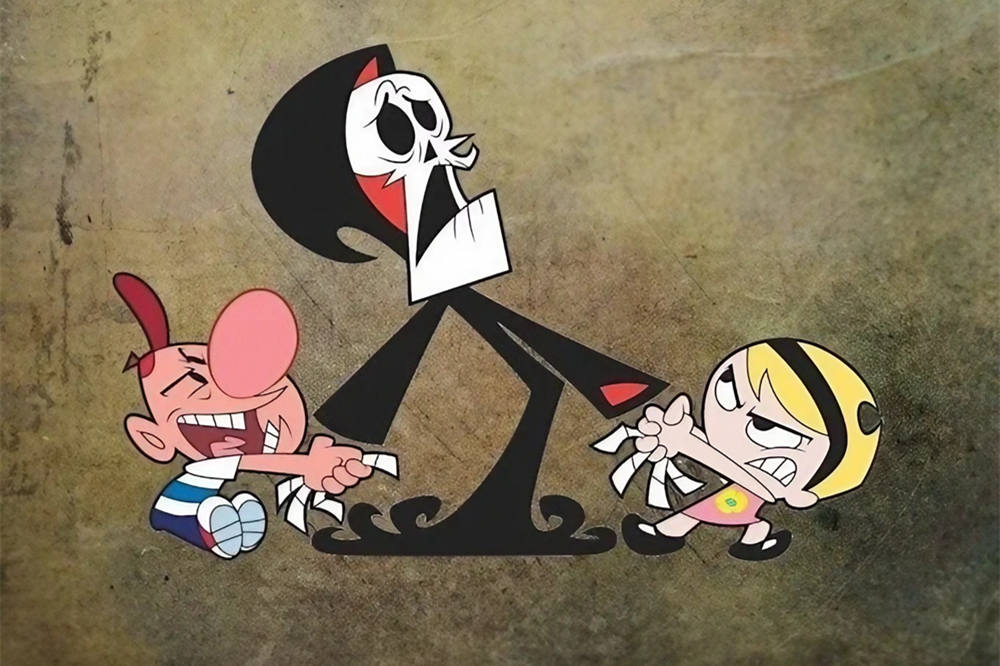
Its characters are visually difficult to confuse with one another. Billy’s broad enthusiasm, Mandy’s tiny expression of permanent disapproval, and Grim’s towering skeletal form communicate their personalities before anyone speaks.
The writing used those contrasts just as effectively. Instead of depending on one kind of joke, the series could move from deadpan dialogue to slapstick, grotesque imagery, supernatural parody, movie references, or complete absurdity.
There is also a useful contradiction at the center of the show: its most frightening-looking character is frequently the one suffering because of two children.
By 2007, contemporary Animation World Network coverage described the program as one of Cartoon Network’s longer-running and popular series. Atoms credited much of that longevity to the relationship among Billy, Mandy, and Grim rather than simply the supernatural premise.
That distinction matters. Monsters and dark jokes gave Billy & Mandy its flavor, but the three incompatible friends gave the show something stable to return to no matter how strange an episode became.
Where Can You Watch The Grim Adventures of Billy & Mandy?
Streaming availability for older Cartoon Network series can change by service and country, so it is worth checking platforms directly before starting a rewatch.
As of August 10, 2026, Warner Bros. maintains an official series page and labels The Grim Adventures of Billy & Mandy as available digitally.
HBO Max also maintains a listing for the six-season series, although availability differs by region and some country-specific HBO Max pages indicate that the title cannot currently be watched there.
Meanwhile, Tubi currently lists the series as “Coming Sep 1,” indicating a planned September 1, 2026 arrival on the service. Because catalog dates and regional rights can change, confirm the current listing before choosing a platform.
A Friendship Strange Enough to Last
The Grim Adventures of Billy & Mandy could have relied entirely on the novelty of putting the Grim Reaper in a children’s cartoon. Instead, it built its identity around something more durable: three personalities that should never have fit together.
Billy turns danger into an opportunity for fun. Mandy tries to control whatever is in front of her. Grim understands exactly how dangerous the supernatural world can be and still ends up dragged into their problems.
The monsters, horror references, strange mythology, and absurd jokes gave the series endless possibilities, but its mismatched friendship gave those possibilities a center. That is why Billy, Mandy, and Grim remain such an immediately recognizable trio from Cartoon Network’s 2000s era.
Featured Image Source: imdb