
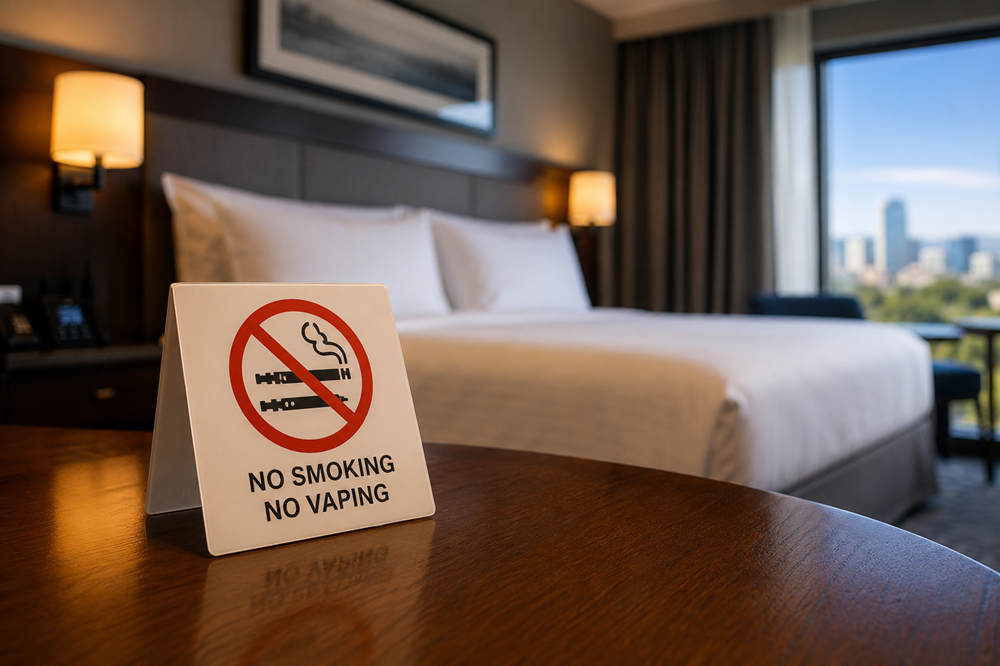
Do Hotels Have Vape Detectors? What Travelers Should Know
Yes, some hotels have sensors designed to detect smoking or vaping in guest rooms, but they are not standard in every hotel. Conventional smoke alarms can also sometimes react to e-cigarette aerosol. Most importantly, a hotel can prohibit vaping and charge a cleaning or smoking fee whether or not a dedicated vape detector is installed.
If you vape while traveling, checking the property’s smoking policy is much more useful than trying to identify the devices on the ceiling.
Do Hotels Have Vape Detectors?
Some hotels do use specialized sensors to help enforce smoke-free guest-room policies. However, there is no reason to assume that every hotel, every chain, or even every property within the same brand uses the same equipment.
There are clear examples of the technology being used. The Embassy Suites by Hilton San Juan Hotel & Casino, for example, currently states that its rooms have smoking sensors designed to help detect violations. Its policy specifically prohibits tobacco, vapes, e-cigarettes, and marijuana.
That confirms that specialized monitoring exists in real hotel rooms, but it does not tell us how common it is across the hotel industry. Hotels differ by ownership, brand, building, location, and individual property policy.
Travelers also should not assume that a particular ceiling-mounted device is a vape detector. A hotel room can contain smoke detectors, heat detectors, occupancy sensors, sprinkler equipment, and other building systems that may look similar.
Vape Detectors and Regular Smoke Detectors Are Different
A conventional smoke detector is primarily fire-safety equipment. Dedicated smoking or vaping sensors are designed for a different purpose: helping a property identify possible violations of its indoor smoking policy.
Traditional smoke alarms commonly use photoelectric or ionization technology to respond to particles in the air. They are not necessarily designed to identify whether those particles came from a cigarette, an e-cigarette, cooking, or another source.
Dedicated hotel monitoring systems may use different combinations of air-quality or particulate sensing and can sometimes alert hotel staff when a suspected smoking event occurs. The exact capabilities depend on the system being used.
For travelers, there is little practical value in trying to identify which type of equipment a room contains. Hotel rules apply regardless of whether the property uses specialized monitoring.
Can Vaping Set Off a Hotel Smoke Detector?
Yes, vaping can trigger some conventional smoke detectors, although it will not necessarily activate every detector every time.
E-cigarettes create an aerosol containing airborne particles. Because conventional smoke detectors respond to particles in the air, those aerosols can sometimes cause an alarm. A peer-reviewed paper published in Tobacco Control notes that e-cigarette aerosol can trigger both ionization and photoelectric smoke detectors.
The response can depend on the detector, the surrounding environment, and other conditions, so there is no reliable rule that vaping will always trigger an alarm or that it never will.
For a hotel guest, that uncertainty is reason enough not to treat a conventional smoke detector as irrelevant simply because no obvious dedicated vape sensor is visible.
Do Hotels Allow Vaping in Guest Rooms?
Many smoke-free hotels include vaping in their indoor-smoking restrictions. Some properties state this explicitly, while others publish a broader nonsmoking policy that guests should clarify before vaping anywhere on the property.
For example, Hyatt Place San Francisco / Downtown currently describes its smoke-free environment as including vaping. Rooms found to have been smoked in can be subject to a fee of at least $250 per night plus tax.
The important distinction is that a hotel’s policy determines what guests are allowed to do—not whether a particular detection device happens to be installed.
If your reservation says “non-smoking” but does not specifically mention e-cigarettes, do not assume that vaping is permitted. Check the property’s official policy or ask the hotel directly.
Can a Hotel Charge You for Vaping?
Yes. A hotel may impose a smoking, cleaning, or room-recovery fee if it determines that a guest violated its smoke-free policy.
There is no standard industry-wide amount. Some properties charge a few hundred dollars, while individual hotel policies can set considerably higher fees. The amount can also change, so it is better to check the actual property’s terms rather than relying on a figure quoted for another hotel.
These fees generally reflect the hotel’s policy rather than the type of detection technology involved. A property can assess a smoking-related charge based on its established procedures even if no dedicated vape sensor was used.
How Can Hotels Enforce No-Vaping Rules Without Vape Detectors?
Specialized sensors are only one way a hotel can identify possible smoking or vaping in a room.
Housekeeping observations can also play a role. Marriott’s published smoke-free hotel policy, for example, says housekeepers are trained to observe signs of smoking as part of the company’s enforcement process.
Other situations may involve a guest complaint, an odor noticed in a room or hallway, or an inspection by hotel staff. Hotels may then follow their own procedures for documenting a suspected policy violation.
This is another reason the question “Does my room have a vape detector?” is less useful than “Does this hotel allow vaping, and where?”
How to Check a Hotel’s Vaping Policy Before Your Stay
If one or both of you vape, spending a minute checking the rules before a couples trip can prevent a frustrating dispute or an unexpected charge.
- Check the hotel’s official website. Look under Hotel Policies, Smoking Policy, Property Information, or a similar section.
- Look specifically for “vaping” or “e-cigarettes.” Some hotels explicitly include them in their smoke-free rules.
- Check outdoor spaces separately. A balcony or patio is not automatically an approved vaping area.
- Look for any published smoking or cleaning fee. This tells you what financial consequence the property may apply.
- Contact the hotel if the wording is unclear. Ask where vaping is permitted rather than asking whether the hotel uses detectors.
Hotel policies can vary even within a large chain. Hilton, for example, directs travelers to check the smoking policy of the individual property because availability of smoking rooms and other rules can differ between hotels.
What Should Travelers Who Vape Do at a Hotel?
The simplest approach is to treat a nonsmoking guest room as a non-vaping room unless the hotel clearly states otherwise.
- Use designated smoking or vaping areas when available.
- Ask the front desk where vaping is permitted if you are unsure.
- Do not assume bathrooms, balconies, hallways, or stairwells are exempt from the policy.
- Remember that local laws may place additional restrictions on indoor vaping.
- Never cover, disconnect, remove, or interfere with smoke alarms or other hotel safety equipment.
For couples traveling together, this is especially worth discussing before booking if only one person vapes. A hotel with an easily accessible outdoor smoking area may be considerably more convenient than a completely smoke-free resort where leaving the property is necessary.
What If You Are Charged a Vaping Fee by Mistake?
If a hotel charges you for smoking or vaping and you believe the charge is incorrect, ask the property to explain why the fee was applied rather than immediately assuming a detector caused it.
- Request the specific policy involved. Confirm exactly what rule the hotel says was violated.
- Ask what led to the charge. Find out whether it resulted from a staff inspection, housekeeping report, sensor alert, complaint, or another form of documentation.
- Request an itemized bill. Make sure you know exactly what the additional charge represents.
- Keep your documentation. Save your reservation confirmation, receipts, relevant photographs, and messages exchanged with hotel staff.
- Ask hotel management to review the charge. If the property cannot resolve the issue, you can then use the hotel chain’s formal customer-service process where applicable.
A smoking fee does not automatically mean a specialized sensor was involved, and a sensor alert does not explain every possible dispute. Asking the property how it reached its decision gives you a clearer basis for challenging a charge you believe is incorrect.
Bottom Line
Some hotels have dedicated sensors that can help detect smoking or vaping, while many others rely on conventional fire-safety equipment and normal hotel enforcement procedures. Vaping aerosol can also trigger some regular smoke detectors.
But the hotel’s policy is what ultimately matters. Before vaping at a hotel, check where it is permitted and whether the property imposes a fee for violations. That is more reliable—and much less stressful—than trying to guess what the equipment in your room can detect.