Which Excerpt From The Adventures of Huckleberry Finn Contains Humor?
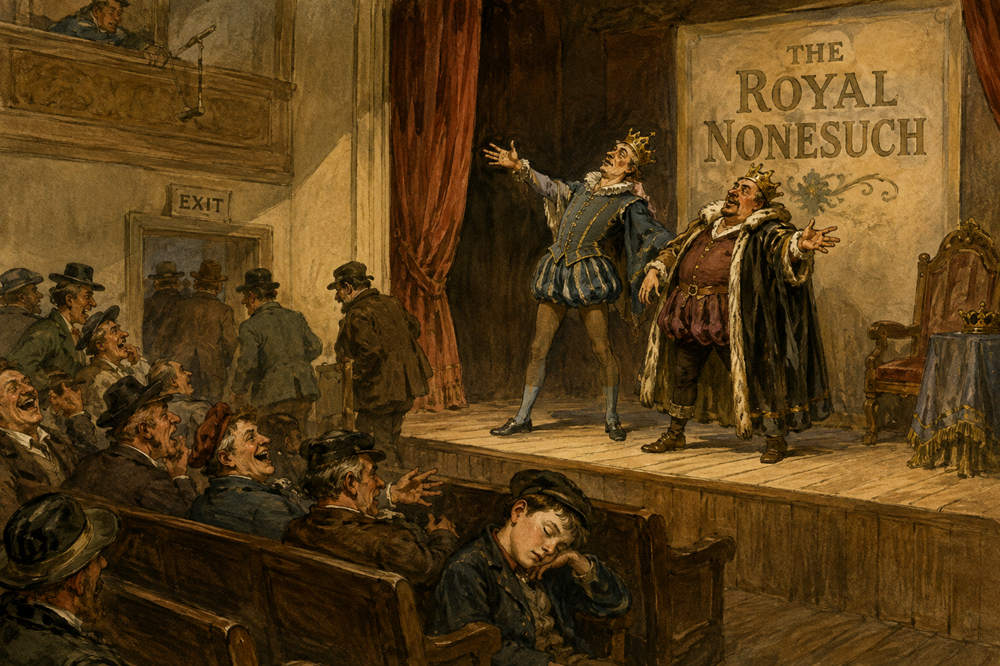
The humorous excerpt is the Chapter XXII passage in which the audience laughs throughout the duke’s theatrical performance, leaves before the show is finished, and only one boy remains because he has fallen asleep.
The key line begins, “And they laughed all the time…” The humor comes from the sharp contrast between the duke’s confidence in his acting and the audience’s complete lack of appreciation for it. Mark Twain makes the scene even funnier through irony, the duke’s wounded pride, and Huck’s matter-of-fact narration.
What Is Happening in the Humorous Excerpt?
Before this scene, Huck and Jim have fallen in with two traveling con men who call themselves the king and the duke. The pair repeatedly invent schemes to make money from the people they meet along the Mississippi River.
The duke considers himself a capable actor and has been preparing a theatrical show involving Shakespearean material. When the performance finally takes place, however, only about twelve people attend—just enough to cover the expenses.
The small audience is not impressed. Instead of responding with admiration, the spectators laugh through the performance. Their reaction makes the duke angry, and almost everyone leaves before the show ends.
Twain finishes the scene with its most memorable comic detail: the only boy who remains is asleep.
The scholarly text of Chapter XXII preserves the sequence clearly. The duke expects to present serious theater, but his performance ends with an amused audience, an empty room, and one unconscious spectator.
Why Is the Excerpt Funny?
Twain does not rely on a single joke. The scene works because several forms of humor reinforce one another.
Situational Irony Reverses the Duke’s Expectations
The most obvious technique is situational irony: what actually happens is almost the opposite of what the duke expects.
He wants the audience to respect his performance. Instead, they laugh at it. For a comedian, laughter might be a sign of success, but the duke is trying to present himself as a serious actor. The response therefore becomes embarrassing rather than flattering.
His anger adds another layer to the joke. He does not consider that his acting might be the problem. He assumes the audience lacks the sophistication to appreciate it.
The Sleeping Boy Acts Like a Punch Line
The final detail about the sleeping boy gives the scene its strongest comic finish.
Twain could simply have said that everyone left. Instead, one spectator remains—but only because he has fallen asleep.
That turns an ordinary failed show into something more absurd. The duke has not merely failed to impress his audience; he has failed to keep the last person in the room awake.
The Duke’s Self-Importance Creates Character Humor
The duke is especially funny because he takes himself so seriously.
His confidence is completely out of proportion to his success. When the audience rejects the show, he protects his pride by blaming the spectators rather than reconsidering his own talent.
This makes the humor partly character-based. Readers can see the gap between the duke’s opinion of himself and what everyone else sees.
Huck’s Understated Voice Makes the Scene Funnier
Huck does not stop to explain why the performance is ridiculous. He simply reports what happens.
That straightforward style lets the situation provide its own comedy. The audience laughs, the duke gets angry, people walk out, and a boy sleeps through the rest. Huck’s restrained narration makes the embarrassment feel even sharper because he does not exaggerate it for the reader.
How the Failed Performance Leads to the Royal Nonesuch
The unsuccessful show is important because it immediately gives the duke an idea for a new scheme.
Rather than accepting that the performance failed, he decides the local audience does not appreciate Shakespeare and would prefer “low comedy.” The following morning, he prepares handbills for a new attraction called The King’s Camelopard, or The Royal Nonesuch.
The advertisement includes a particularly calculated line stating that women and children will not be admitted. The duke believes that suggestion alone will make the townsmen curious enough to pay.
It works.
The Royal Nonesuch becomes a deliberately outrageous and extremely short performance. The paying audience soon realizes that it has been tricked. Yet the embarrassed spectators do not want the rest of town to know how easily they were fooled, so they encourage other people to attend as well.
The comedy therefore grows beyond the duke’s bad acting. Twain shifts attention toward pride and group behavior: people who have been deceived become willing to help deceive their neighbors rather than admit their own mistake.
Humor and Satire Work Together in the Scene
The passage is funny, but Twain’s comedy often does more than entertain.
Humor creates the immediate amusement: the duke’s failed performance, his irritation, the departing audience, and the sleeping boy. Satire uses that comedy to expose foolish behavior.
The duke is one target. He is dishonest, vain, and unwilling to recognize his own limitations. The townspeople later become another. Their curiosity draws them to the Royal Nonesuch, and their pride keeps them from openly admitting that the performance fooled them.
This combination appears throughout the novel. The Library of Congress describes Twain’s treatment of Huck and Jim’s encounters with American society as both humorous and satirical. Comedy frequently becomes a way to reveal hypocrisy, vanity, prejudice, violence, or irrational group behavior.
The Chapter XXII excerpt is a relatively light example of that method. Readers can laugh at the performance while also noticing what the duke’s reaction reveals about pride and self-deception.
How to Identify Humor in Similar Huckleberry Finn Questions
When a question asks you to identify a humorous excerpt from Huckleberry Finn, do not look only for an obvious joke. Twain often creates humor through situations and character reactions.
- Look for unexpected reversals. A character expects one response but receives another.
- Notice exaggerated confidence. Twain often makes self-important characters funny by showing how badly reality contradicts their opinions of themselves.
- Watch for absurd final details. A small piece of information, such as the sleeping boy, can function like a punch line.
- Look for irony. Readers may understand why something is funny even when the character involved does not.
- Pay attention to Huck’s narration. His simple, understated descriptions can make ridiculous situations funnier without explicitly announcing the joke.
The duke’s performance contains nearly all of these clues, which is why it stands out so clearly as the humorous excerpt in this question.