How to Travel With Zepbound: Storage, TSA, and Dosing Tips
Some short trips can be completed without refrigerating Zepbound, provided the medicine stays within its labeled temperature and time limits. Longer journeys, hot destinations, and accommodations without reliable climate control require more careful planning.
For couples, it can help to divide the practical tasks. One person might confirm hotel facilities or customs rules while the traveler taking Zepbound manages the medication, documentation, and injection schedule.
Follow the instructions supplied with your prescription and ask your prescriber or pharmacist about questions specific to your health, dose, or itinerary.
Start With the Exact Zepbound Format You Use
Zepbound is available in more than one presentation, and the storage limits are not identical. Before choosing a cooler or deciding whether hotel refrigeration is necessary, check the carton to see whether you have a:
- Single-dose prefilled pen
- Single-dose vial
- Multi-dose vial containing four weekly doses
- Single-patient-use KwikPen containing four weekly doses
Next, count the injection days that fall within the trip and make sure you have the correct medicine and supplies for each dose. Check the expiration date, refill timing, and number of needles or syringes you will need. Early refills sometimes require approval from the pharmacy or insurer, so this is best handled well before departure.
Contact your prescriber before traveling if you are about to increase your dose, have recently started treatment, are experiencing persistent side effects, or will be visiting an area with limited access to medical care. The aim is not to change treatment for the sake of travel, but to avoid discovering an unresolved medication issue after the trip begins.
Zepbound Storage Rules While Traveling
Zepbound is normally refrigerated at 36°F to 46°F, or 2°C to 8°C. All presentations must be protected from heat and light and kept in their original cartons. Zepbound must not be frozen and should not be used if it has frozen.
The current Zepbound prescribing information gives different discard rules based on the presentation:
| Zepbound presentation | Refrigerated storage | When it must be discarded outside normal refrigeration |
|---|---|---|
| Single-dose pen or single-dose vial | 36°F to 46°F until the labeled expiration date | After a cumulative total of 21 days unrefrigerated at no more than 86°F |
| Unopened multi-dose vial or unopened KwikPen | 36°F to 46°F until the labeled expiration date | After 30 days when stored at room temperature at no more than 86°F |
| Opened multi-dose vial or opened KwikPen | May be refrigerated or kept at no more than 86°F | At the earliest of 30 total days at room temperature, 30 days after first use, or four weekly doses |
The phrase cumulative total is particularly important for single-dose pens and vials. Record the date when the medicine first leaves refrigeration and keep track of any later periods spent at room temperature rather than assuming that the count resets.
Does Zepbound Need a Cooler for Every Trip?
Not necessarily. A short trip may fall comfortably within the room-temperature allowance, provided the medicine remains at or below 86°F. In that situation, avoiding unnecessary cooling can also reduce the risk of accidentally freezing it.
A temperature-controlled travel case becomes more useful when:
- The journey may outlast the applicable room-temperature period
- The destination regularly exceeds 86°F
- The itinerary includes long outdoor transfers or remote travel
- The lodging lacks dependable air conditioning or refrigeration
- The medicine has already accumulated substantial time outside refrigeration
If you use frozen gel packs, keep a protective barrier between the packs and the medicine. The purpose is to maintain a safe temperature, not to make the medication as cold as possible.
How to Pack Zepbound and Its Supplies
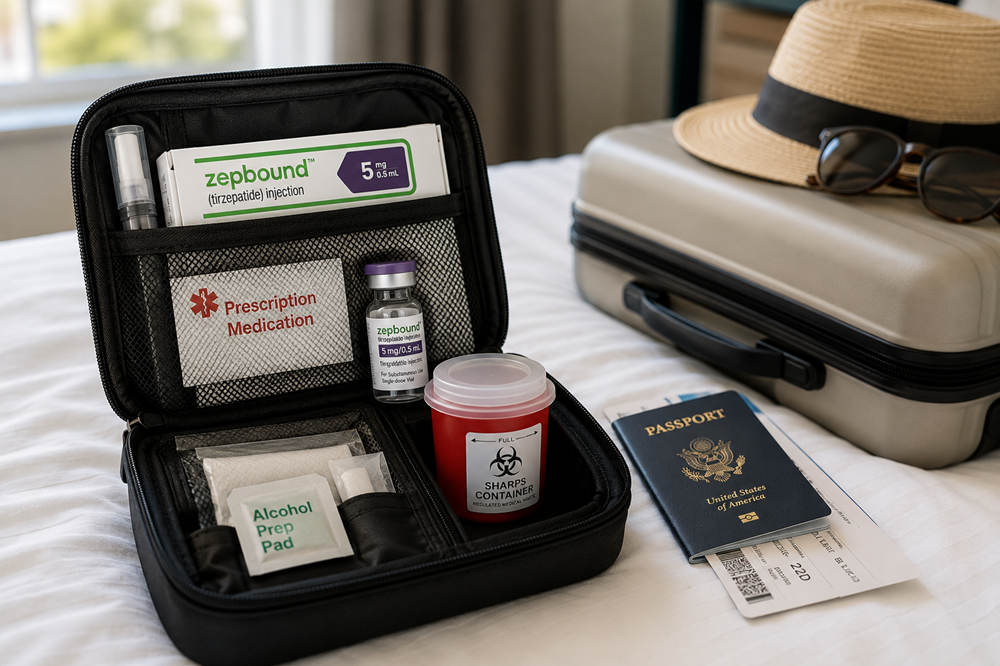
Place Zepbound in a personal item or carry-on that will remain with you. Checked luggage can be lost, delayed, or exposed to temperatures you cannot monitor. A small medication pouch inside the bag also makes security inspection and dosing during the trip easier.
Keep the pharmacy label attached and leave the medication in its original carton. Depending on your prescribed presentation, the same travel kit may also contain:
- The required pen needles or syringes
- Alcohol wipes and a small piece of gauze
- A portable sharps container
- A copy of the prescription or current medication list
- A temperature-control case when needed
- Pharmacy, prescriber, insurer, and manufacturer contact details
Keep unused needles with the injectable medicine rather than loose in a toiletry bag. After an injection, place the needle or syringe directly into a suitable sharps container. The FDA notes that cleared sharps containers are available in smaller travel sizes and recommends carrying a portable container when away from home. Its sharps-disposal guidance also explains what features an alternative hard-sided container should have when a cleared product is unavailable.
Taking Zepbound Through TSA Security
TSA permits prescribed injectable medication through U.S. airport checkpoints. Medically necessary liquids, gels, and aerosols may exceed the standard 3.4-ounce limit when carried in reasonable quantities for the trip, but they must be declared for inspection.
At the checkpoint, tell the officer that you are carrying injectable medication, syringes, and any medically necessary cooling accessories. Present them separately when requested. Medication may be screened by X-ray, visual inspection, or other procedures.
Under the current TSA syringe rules, unused syringes are allowed when accompanied by injectable medicine. Labeling is recommended to make screening easier, although TSA does not universally require prescription labels.
Medically necessary gel packs are allowed in reasonable quantities even if they are partially melted or slushy. Used syringes are also permitted, but they must be transported in a sharps-disposal container or another similar hard-sided container.
The officer at the checkpoint makes the final decision about whether an item can pass through security. Travelers who expect to need additional screening assistance can contact TSA Cares before departure.
Protecting Zepbound During Different Types of Travel
Flights and Airport Connections
Consider the complete door-to-door journey rather than the scheduled flight alone. Ground transportation, check-in, security lines, connections, delays, and the transfer to your accommodation all add to the medicine’s travel time.
Keep the medication somewhere that will not be gate-checked if cabin storage becomes limited. A personal item placed beneath the seat is generally easier to monitor than a roller bag in an overhead compartment.
Road Trips
Do not leave Zepbound in a parked car. Vehicle interiors can quickly become much hotter or colder than the surrounding air. Bring the medication with you during restaurant stops, sightseeing, and overnight stays, and keep it away from direct sunlight and heating vents.
Hotels and Vacation Rentals
When refrigeration is necessary, ask the property what type of refrigerator is available. Do not assume that a minibar maintains 36°F to 46°F or that every part of it stays above freezing. A small thermometer can help you monitor an unfamiliar refrigerator, but the medicine should still be kept away from cooling plates or other areas where it could freeze.
Cruises
Keep the medication in your hand luggage during embarkation rather than in bags collected by porters. Before sailing, ask whether the cabin has suitable refrigeration and how the ship handles used sharps. The onboard medical center may have its own storage and disposal procedures, but availability and policies differ by cruise line and ship.
Injection Days, Missed Doses, and Time Zones
Zepbound is used once weekly and may be taken at any time of day. Crossing time zones does not usually require changing the weekly injection day, but the interval since the previous dose matters more than matching the exact clock time used at home.
The regular injection day may be changed when at least 72 hours separate two doses. If a dose is missed, the official instructions say to take it as soon as possible within four days, or 96 hours. When more than four days have passed, skip that dose and take the next one on the normally scheduled day.
Do not take two doses within 72 hours or double a dose to make up for a disrupted travel schedule. Ask your prescriber or pharmacist for a specific plan before departure when crossing the International Date Line or making a larger change to the weekly routine.
International Travel With Zepbound
A prescription issued in the United States does not automatically give you permission to bring Zepbound into every country. Laws, quantity limits, documentation requirements, and rules concerning needles can differ even when a medication is legal and commonly prescribed at home.
Check the foreign embassy or relevant government authority for every country you will visit or pass through, including layover countries. Do not assume that remaining in the international transit area means local medication rules can be ignored.
Use both the brand name Zepbound and the generic name tirzepatide when confirming the rules. The U.S. State Department’s international medicine guidance recommends checking prescription restrictions with each country’s embassy, bringing copies of prescriptions, and carrying a clinician’s letter that lists medicines by their generic names.
For an international journey, prepare:
- The medicine in its original pharmacy-labeled packaging
- A copy of the prescription showing tirzepatide and the prescribed strength
- A clinician’s letter describing the medicine, dose, frequency, injection route, and medical need
- Enough medication for the trip and a reasonable delay, within the destination’s permitted quantity
- Documentation for syringes or needles when required
The CDC’s traveling-abroad-with-medicine guidance also advises carrying medicines in hand luggage, retaining original labels, and asking for a provider note when traveling with injectable medicine.
Avoid assuming that Zepbound can be replaced easily overseas. Brand availability, approved formats, prescribing rules, and supply can differ, and counterfeit medicines are a concern in some countries. An emergency replacement should come through a licensed clinician and legitimate pharmacy.
Planning Around Side Effects as a Couple
If you already know that symptoms tend to occur after an injection, avoid placing the most demanding part of the itinerary immediately afterward. A flexible evening, access to familiar food, nearby restrooms, and time to rest can make the trip easier without allowing the medication schedule to control the entire vacation.
Your partner should know where to find the medication list, insurance information, clinician contact details, and emergency documents. Assistance with an injection should be limited to someone who has received appropriate instruction for the prescribed Zepbound presentation.
Follow the medication guide and contact a healthcare professional for severe or persistent gastrointestinal symptoms. Seek prompt medical care for alarming symptoms such as severe abdominal pain, signs of a serious allergic reaction, or ongoing vomiting or diarrhea that may lead to dehydration.
What to Do if Zepbound Is Frozen, Overheated, Lost, or Damaged
Frozen Medicine
Do not use Zepbound that has frozen, even if it later thaws or looks normal. Contact your pharmacist or prescriber about replacing it and managing the next scheduled dose.
Uncertain Heat Exposure
If the medication may have exceeded 86°F, note the highest estimated temperature and how long the exposure lasted. Use Lilly’s temperature-exposure assessment tool or contact a pharmacist or Lilly before deciding whether to use the dose.
Lost or Stolen Medication
Contact the dispensing pharmacy, prescriber, and insurer as soon as possible. When abroad, use a licensed local medical provider rather than purchasing a replacement through an informal seller or uncertain website.
Damaged or Unusual-Looking Medicine
Do not inject medicine from a leaking or damaged container. Zepbound should appear clear and colorless to slightly yellow. Ask a pharmacist or the manufacturer for guidance if it appears cloudy, discolored, or contains particles.
Zepbound Travel Checklist
- Identify whether you use a single-dose or multi-dose product.
- Count the doses and injection supplies needed for the itinerary.
- Record any time already spent outside refrigeration.
- Choose a storage plan based on trip length and expected temperature.
- Keep the labeled medicine and sharps container in hand luggage.
- Save the date and time of your most recent injection.
- Carry prescription documentation for international travel.
- Verify the rules of every destination and transit country.
Final Thoughts
Traveling with Zepbound is usually manageable when the storage plan matches the exact medication presentation. The most important steps are to prevent freezing and excessive heat, keep the medicine and injection supplies accessible, maintain the correct interval between doses, and confirm foreign entry rules before crossing a border.
Couples can make the process easier by sharing the research and logistics without separating the medication from the information needed to use it safely. A few checks before departure can prevent a temperature, screening, or documentation problem from disrupting the trip.