Why Don’t Hotels Have a 13th Floor? The Real Reason Explained
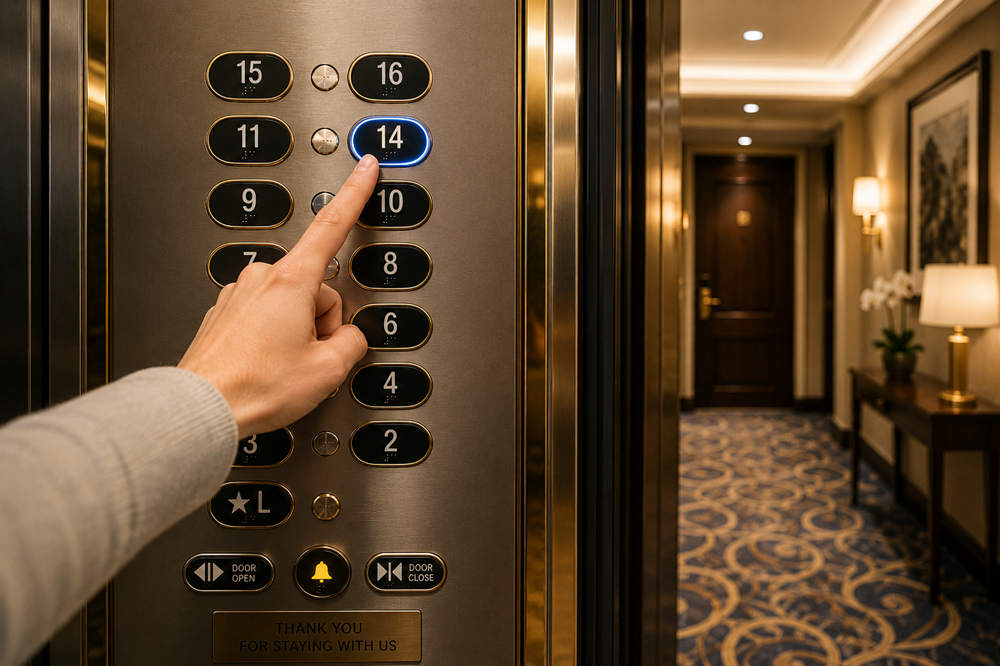
Step into some hotel elevators and the buttons run 10, 11, 12, 14. The obvious question is: what happened to the 13th floor?
Usually, nothing happened to it. The physical floor is still there; the hotel has simply skipped the number 13 and labeled the next level 14. The tradition comes from the longstanding Western superstition that 13 is unlucky. However, not every hotel follows it, and plenty of properties use the number 13 normally.
Why Don’t Some Hotels Have a 13th Floor?
Some hotels omit 13 from their floor numbering because of the superstition surrounding the number. Fear or strong aversion to 13 is commonly called triskaidekaphobia.
The practice is especially familiar in the United States and other places influenced by Western traditions surrounding unlucky 13. Instead of labeling successive floors 11, 12, 13, and 14, a property might label them 11, 12, 14, and 15.
That does not mean every hotel owner believes the number brings bad luck. In most cases, it is simply a numbering convention that avoids a number some guests would rather not encounter during their stay.
What Actually Happens to the Missing 13th Floor?
The most important thing to understand is that hotels generally are not leaving an empty story between Floors 12 and 14.
If an elevator travels directly from 12 to 14, the floor labeled 14 is normally the next physical level in the building. In ordinary sequential counting, it would have been Floor 13 if the hotel had not skipped the number.
The Smithsonian describes this practice as buildings having a 13th floor but effectively mislabeling it in the elevator.
So if you book a room on Floor 14 in a hotel that skips 13, you may technically be staying on the building’s 13th above-ground level. There is no mysterious vacant space below your room.
Floor numbers can also become complicated for unrelated reasons. Hotels may contain mezzanines, parking levels, mechanical spaces, multiple towers, or lobbies located above street level. Because of that, the number beside your hotel room does not always tell you exactly how many physical stories are below it.
Why Is 13 Considered Unlucky?
The origins of the superstition are not completely settled. Rather than coming from one proven historical event, the unlucky reputation of 13 appears to have accumulated through several religious and cultural traditions.
Thirteen Comes After a Symbolically Important 12
One explanation begins with the number 12, which appears repeatedly in systems associated with order and completeness. There are 12 months in a year and 12 signs of the zodiac, while Greek tradition includes 12 Olympian gods and Christian tradition includes 12 apostles.
One theory is that 13 acquired an uncomfortable reputation partly because it comes immediately after a number with so many associations with completeness. National Geographic’s examination of the superstition discusses this explanation alongside its religious roots.
The Last Supper
Christian tradition is another major influence. Jesus and his 12 apostles made 13 people at the Last Supper, and Judas Iscariot is associated with the betrayal of Jesus that followed.
This contributed to a longstanding superstition surrounding groups of 13 people dining together and, more broadly, to negative associations with the number.
The Norse Story of Loki
A commonly repeated Norse tradition also involves an unfortunate 13th guest. In the story, Loki arrives at a gathering of 12 gods and events ultimately lead to the death of Balder.
These explanations are better understood as parts of the folklore surrounding 13 rather than a single definitive answer to where the superstition began.
Why Do Modern Hotels Still Skip 13?
For a hotel, skipping the number can be a simple way to remove a potential source of discomfort.
A traveler who has no feelings about 13 is unlikely to be bothered when an elevator goes directly from 12 to 14. Someone who is strongly superstitious, however, may be uncomfortable staying in Room 1313 or sleeping on a floor clearly labeled 13.
Changing a floor label is therefore easier than dealing with guests who want to move after check-in. Once this convention became familiar in hotels and other high-rise buildings, it also became easy for newer properties to continue it.
The custom illustrates how a superstition can influence everyday design even when many of the people using the building do not personally believe in it.
Do All Hotels Skip the 13th Floor?
No. There is no universal hotel rule requiring properties to omit Floor 13.
Some hotels openly use the number. At the Chicago Athletic Association, for example, Hyatt describes Cindy’s rooftop restaurant as sitting on the 13th floor.
The Blossom Hotel Houston, part of Hilton’s Curio Collection, also identifies its rooftop Plum Skybar and Lounge as being on the 13th floor.
So you may stay at one hotel where the elevator jumps from 12 to 14 and another where 13 appears without fanfare. The choice depends on the individual property, building conventions, local culture, and decisions made by its developers or operators.
Do Hotels Skip Other Floor Numbers?
They can. Ideas about unlucky numbers vary between cultures, so 13 is not the only number travelers may notice missing.
One well-known example is the number 4 in parts of East Asia. In languages including Chinese, Japanese, Korean, and Vietnamese, words or pronunciations associated with four can resemble words associated with death. The resulting aversion is often called tetraphobia.
Because of these cultural associations, travelers may occasionally encounter buildings that avoid certain uses of the number 4, just as some Western buildings avoid 13. Practices vary widely, however, and it would be inaccurate to assume that every hotel in a particular country follows the same system.
Unusual numbering can also have nothing to do with superstition. Building additions, mechanical levels, different wings, and unusual lobby layouts can all produce floor sequences that look strange to a guest.
If your actual height within a building matters—for example, because you prefer a lower floor or want to be closer to an exit—it is better to confirm the room’s location with the hotel instead of relying solely on its number.
Does Staying on a 13th Floor Matter?
From a practical travel perspective, there is nothing inherently different about a room simply because it is on a level numbered 13.
Likewise, calling the same physical level Floor 14 does not make it structurally different. The number on the elevator is a label, not a measure of the floor’s safety or quality.
If you are traveling as a couple and either partner feels uncomfortable staying on Floor 13, there is no need to make it a major issue. Ask the front desk whether a room on another floor is available. Hotels commonly handle room-location preferences, although fulfilling a request depends on availability and the room categories available at that property.
It is worth making the request before arrival when the issue matters to you. A hotel may be able to note the preference on the reservation, but that should not be treated as a guarantee unless the property specifically confirms it.
If neither of you cares about the superstition, there is no practical reason to avoid a room solely because its floor number is 13.
The Bottom Line
When a hotel appears not to have a 13th floor, it usually means the number has been skipped rather than the physical story. The elevator may go from 12 directly to 14, but those two floors normally remain directly above and below one another.
The convention grew from the Western superstition that 13 is unlucky, a belief with several possible cultural and religious roots rather than one proven origin. Some hotels continue to accommodate that superstition because changing a floor number is simple and can prevent discomfort for certain guests.
But it is far from a universal rule. Many hotels use Floor 13 normally, while different cultures may have their own number-related customs.
So when you notice 13 missing from a hotel elevator, the explanation is usually much less mysterious than it looks: the floor is still there. Only the number is missing.