
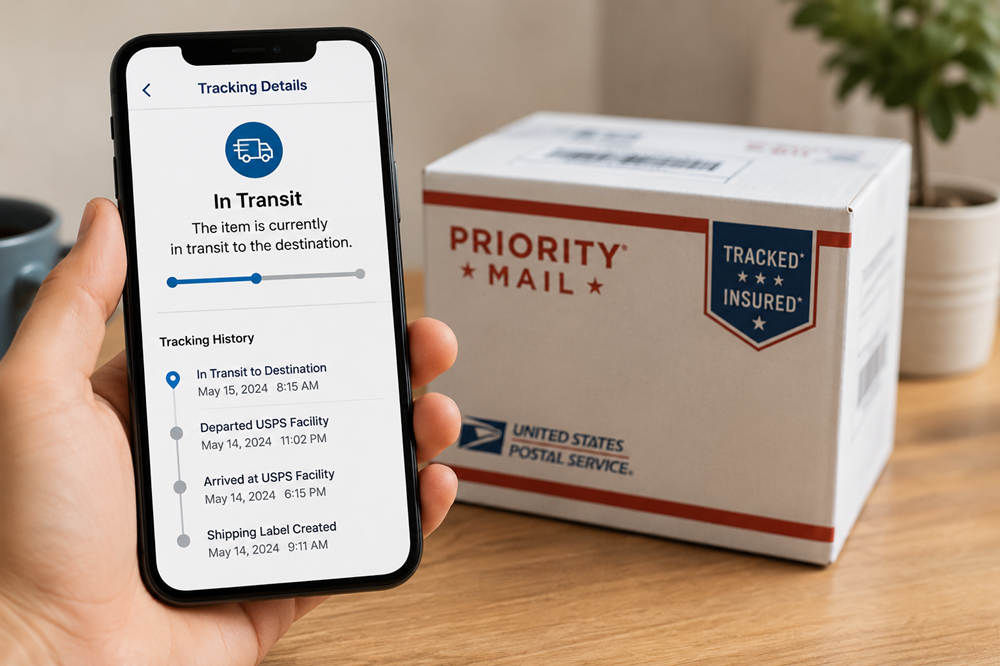
“The Item Is Currently in Transit to the Destination”: USPS Tracking Meaning
If your tracking says “the item is currently in transit to the destination,” the package is generally still moving through the shipping network toward the place where it will eventually be delivered. It does not mean the package is lost, and it does not necessarily mean it has already reached your city.
For USPS shipments, comparable tracking updates appear under “Moving Through Network.” At this stage, the package may still need to pass through one or more facilities before reaching the local Post Office and moving out for delivery.
What Does “The Item Is Currently in Transit to the Destination” Mean?
In simple terms, the package has entered the transportation process and has not yet reached the final delivery stage.
For USPS, current tracking terminology includes statuses such as “In Transit,” “Arrived at USPS Facility,” and “Departed USPS Facility.” USPS explains that these mean the package is being processed or transported toward the Post Office that will ultimately handle its delivery.
These tracking events can appear more than once as a package moves through the network. Seeing another “In Transit” update therefore does not necessarily indicate that the parcel has returned to the same stage or encountered a problem.
The word destination can also be misleading. It does not automatically mean your home, hotel, apartment, or other delivery address. At a particular point in the journey, the next destination may simply be another USPS processing facility.
Where Is Your Package Right Now?
An in-transit status does not provide an exact real-time location. Package tracking is based on events recorded as a shipment passes through different parts of the carrier’s network.
Your parcel may currently be:
- Traveling from one USPS facility to another
- Being sorted or processed at a distribution center
- Waiting for its next scheduled transportation connection
- Heading toward the USPS facility serving your region
- Approaching the local Post Office but not yet checked in there
The latest scan shows the most recent recorded stage of the journey rather than a continuous GPS location. That is why a package can be moving even though the tracking page has not changed recently.
Does “In Transit to the Destination” Mean It Is Coming Today?
No. An in-transit message by itself does not mean you should expect delivery that day.
For a USPS package, the more important statuses to watch for are “Arrived at Post Office” and “Out for Delivery.”
“Arrived at Post Office” means the package has reached the local Post Office responsible for delivery and is being prepared for the final stage of its journey.
“Out for Delivery” goes a step further. USPS says this status means the package has been prepared for delivery at the local Post Office and is expected to be delivered by a carrier that day.
So if your tracking still says “In Transit,” the parcel may be making good progress, but there is not enough information in that status alone to conclude that delivery will happen today.
How Long Can a Package Stay in Transit?
There is no universal number of hours or days that a package should remain in an in-transit status.
Timing depends partly on the mail service being used. Current USPS delivery standards, for example, vary by service. Priority Mail generally has a shorter expected transit period than services such as USPS Ground Advantage or Parcel Select.
Other factors can also affect how quickly a shipment reaches the next stage:
- Distance between the sender and recipient
- Weekends and postal holidays
- Seasonal package volume
- Severe weather or transportation disruptions
- Routing through multiple processing centers
- The specific shipping service purchased
The estimated delivery date is therefore more useful than assuming that an in-transit status should change every few hours.
A parcel that has not received a recent scan but is still within its normal delivery window may be progressing normally.
Why Has the Tracking Status Not Updated?
A tracking page that stays unchanged does not necessarily mean the physical package has stopped moving.
Carriers record packages at particular points during transportation. There can be a significant period between those events, especially when a shipment is covering a long distance.
FedEx, for example, says packages are scanned at different points between pickup and delivery and that going more than 24 hours without an update is not unusual during transit. The package may simply be traveling toward the next place where it will be scanned.
USPS tracking can work similarly from the customer’s perspective: additional information appears as the package reaches later stages in the network.
In other words, a quiet tracking page and a stationary package are not necessarily the same thing.
When Should an In-Transit Package Start to Concern You?
The status itself is not a warning. Concern becomes more reasonable when the tracking history and expected delivery date together suggest that normal progress has stopped.
Pay closer attention if:
- The estimated delivery date has already passed
- There have been no meaningful tracking changes for an unusually long period
- The tracking page displays a specific delay, alert, or exception
- The package appears to have been routed incorrectly
- The carrier’s tracking page says the shipment is eligible for additional research or another action
USPS notes that an item may still be in transit rather than lost or delayed depending on the mail class and how long ago it was sent. This is why comparing the shipment with the delivery standard for the service is more useful than treating one unchanged tracking message as proof of a problem.
What to Do If Your Package Seems Stuck in Transit
If the expected delivery date is approaching or has already passed, work through a few checks before assuming the shipment is lost.
- Review the full tracking history. The most recent facility, departure event, or alert can provide more context than the headline tracking status.
- Check the expected delivery date. A shipment still within the carrier’s normal delivery window may not require any action yet.
- Check for service disruptions. Weather, natural disasters, transportation problems, and unusual package volumes can affect movement through parts of the network.
- Sign up for tracking notifications. USPS provides text and email tracking updates, which can be more convenient than repeatedly refreshing the tracking page.
- Contact the sender when appropriate. If you bought the item from a retailer or marketplace seller, the shipper may have additional information or may need to start a claim or investigation.
- Follow the carrier’s delayed-package procedure. USPS advises customers to check the applicable delivery standards and tracking information before escalating a delayed shipment. If the tracking system says additional research is available, follow the instructions provided there.
If the package contains something needed for a particular date—such as wedding supplies, travel documents, honeymoon essentials, or an item being sent to a hotel—it can make sense to prepare an alternative even before the shipment meets the carrier’s definition of missing.
What Does This Status Mean for an International Package?
International shipments introduce additional steps, so an in-transit message needs to be interpreted carefully.
Do not assume that “to the destination” means the package has already reached the destination country. Unless the tracking history specifically records an arrival in that country, the parcel could still be moving through the originating postal network or an international transportation hub.
International packages may also be transferred from one postal operator to another. That handoff can result in different tracking terminology or a period with fewer visible updates.
Customs is another separate stage. If tracking specifically states that a package is being held or reviewed by customs, the parcel must complete that process before normal delivery movement can resume.
Canada Post, for example, uses “Item held by customs” as a distinct status and explains that customs-clearance times can vary depending on the shipment, documentation, and processing volume.
For an international parcel, therefore, look for specific events such as arrival in the destination country, customs processing, customs clearance, or transfer to the local postal operator rather than relying on the general word “destination.”
USPS Tracking Statuses You May See Next
| Status | What It Means |
|---|---|
| Arrived at USPS Facility | The package has reached another USPS processing location and remains in the transportation network. |
| Departed USPS Facility | The package has left a processing location and is continuing toward another facility or the delivering Post Office. |
| Arrived at Post Office | The package has reached the local Post Office and is being prepared for delivery. |
| Out for Delivery | The package has been prepared for final delivery and USPS expects a carrier to deliver it that day. |
| Available for Pickup | The item is available at the designated postal location instead of continuing directly to doorstep delivery. |
| Delivered | USPS has recorded the package as delivered, along with a delivery date, time, and location. |
Other carriers use different terminology. UPS, for example, commonly uses “Shipped/On the Way,” while Canada Post uses “In transit.” The wording may change, but the basic distinction is similar: being in the transportation network is different from being out for final delivery.
The Bottom Line
When tracking says “the item is currently in transit to the destination,” it generally means the package is still progressing through the carrier’s network. For USPS shipments, comparable “In Transit” events mean the parcel is being processed or transported toward the Post Office that will handle delivery.
It does not mean the package is lost, nor does it guarantee delivery that day. Watch the estimated delivery date and the next tracking event. Once USPS shows “Arrived at Post Office” or especially “Out for Delivery,” the package has moved much closer to your door.
If the expected delivery window passes without meaningful progress, check the latest tracking instructions and use the carrier’s official delayed-package process rather than relying on the wording of the in-transit status alone.