
15 Books for Couples to Read Together, From Date Nights to Road Trips
Reading together offers couples a scrry. It can become part of a quiet date night, a beach afternoon, a long flight, or an audiobook-filled road trip.
The following books were selected for their discussion value, accessibility, variety, and ability to inspire either a stronger relationship or a shared experience. The list includes practical relationship guides, conversation-worthy fiction, travel writing, and an interactive book for planning future adventures.
Relationship Books That Encourage Better Conversations
1. Eight Dates by John Gottman, Julie Schwartz Gottman, Doug Abrams, and Rachel Carlton Abrams
Best for: Couples who want guided conversations about their future.
Eight Dates turns important relationship topics into eight planned dates. Each one focuses on a different subject, including trust, conflict, money, intimacy, family, play, personal growth, and shared dreams.
The format makes the book especially approachable for partners who want to talk more deeply without making the evening feel like a formal relationship exercise. Instead of reading it straight through, plan one date at a time and give each conversation room to develop. You do not need to agree on every answer; the value comes from understanding how your partner sees the relationship and the life you are building together.
2. Hold Me Tight by Sue Johnson
Best for: Partners who want greater emotional closeness.
Some arguments appear to be about chores, plans, or a careless comment, but the stronger emotion underneath may be fear of rejection or disconnection. Grounded in Emotionally Focused Therapy, Hold Me Tight guides couples through seven conversations designed to build a more secure bond.
The book helps readers recognize recurring patterns, such as one partner seeking reassurance while the other withdraws to avoid escalating the situation. Once couples can see the pattern, they may find it easier to work together instead of blaming each other. This is a thoughtful choice for partners who are comfortable slowing down and discussing vulnerable feelings.
3. Fight Right by Julie Schwartz Gottman and John Gottman
Best for: Couples who want to disagree more constructively.
Conflict is not necessarily evidence of a failing relationship. What matters is how disagreements begin, how each person reacts under pressure, and whether the couple can repair the connection afterward.
Fight Right helps partners examine their individual conflict styles and the experiences that shaped them. It is most useful when read slowly, with time to discuss what usually happens during an argument. Couples can identify the point where a disagreement tends to become unproductive and decide how they will pause, listen, or reconnect differently the next time.
4. Mating in Captivity by Esther Perel
Best for: Long-term couples curious about intimacy and desire.
Security and familiarity are important parts of a lasting partnership, but they can exist in tension with novelty, mystery, and erotic energy. In Mating in Captivity, Esther Perel examines how couples can remain close without losing their sense of individuality.
The book is more reflective than instructional. It encourages discussion about routine, privacy, playfulness, imagination, and the ways desire may change over time. Partners may not agree with every argument, but those differences can lead to honest conversations about subjects they rarely discuss directly.
5. Money for Couples by Ramit Sethi
Best for: Partners with different spending and saving habits.
Money influences where couples live, how they travel, which risks they can take, and what kind of future they imagine. Money for Couples encourages both partners to participate in financial decisions rather than allowing one person to manage everything.
This is especially useful when one partner prefers saving and the other is more comfortable spending. Instead of treating either habit as automatically correct, the book helps couples define what a satisfying life looks like to them. That conversation can then guide decisions about debt, everyday expenses, major purchases, and experience-based goals such as a honeymoon, sabbatical, or extended trip.
Fiction Books Couples Can Discuss Long After Reading
6. The Course of Love by Alain de Botton
Best for: Couples interested in the reality of long-term love.
Many romantic stories end when two people finally choose each other. The Course of Love follows what comes next: marriage, daily routines, misunderstandings, parenthood, disappointment, and the gradual development of a more realistic kind of love.
The novel combines the story of Rabih and Kirsten with philosophical observations about their behavior. That unusual structure invites couples to consider how childhood, pride, expectations, and unspoken needs influence adult relationships. Rather than presenting love as a permanent emotional high, the book asks whether it is a skill that partners continue learning over time.
7. Pride and Prejudice by Jane Austen
Best for: Couples who enjoy classics, wit, and slow-building romance.
Elizabeth Bennet and Mr. Darcy are intelligent, observant, and frequently mistaken about each other. Their story offers far more than romance, exploring first impressions, family expectations, social pressure, pride, and the difficulty of admitting that an early judgment was wrong.
Couples may disagree about which character behaves more unfairly or which misunderstandings could have been avoided. Those different interpretations make the book enjoyable to discuss chapter by chapter. After finishing it, choose a screen adaptation for a book-and-movie date and compare how the actors and filmmakers interpreted the relationship.
8. The Princess Bride by William Goldman
Best for: Partners looking for a funny, adventurous read.
The Princess Bride mixes true love with sword fights, revenge, kidnappings, giants, narrow escapes, and a narrator who repeatedly interrupts the tale. It is a good choice when both partners want something lighter than a relationship guide or serious literary novel.
The humor gives couples plenty to quote and laugh about, while the story still raises questions about loyalty, courage, sacrifice, and romantic idealism. Finish the book with a movie night, then compare the scenes that worked better on the page with those that became more memorable on screen.
9. A Gentleman in Moscow by Amor Towles
Best for: Readers who prefer atmospheric, character-driven stories.
Count Alexander Rostov is sentenced to house arrest inside Moscow’s Hotel Metropol, where he must create a meaningful life within sharply restricted surroundings. Over the years, the hotel becomes a complete world filled with friendships, routines, meals, secrets, and unexpected responsibilities.
The novel gives couples several ideas to discuss without centering on romance. What makes a place feel like home? How much control do people need to live well? What gives life meaning when carefully made plans disappear? Its elegant hotel setting also creates a sense of literary travel, making it a fitting book for a quiet weekend away.
10. Project Hail Mary by Andy Weir
Best for: Couples who enjoy science, suspense, and problem-solving.
A man wakes aboard a spacecraft with limited memories and gradually realizes that his mission may determine whether humanity survives. Project Hail Mary combines a scientific mystery with humor, survival, sacrifice, and an unexpected friendship.
The story is easy to discuss while it unfolds. Couples can compare predictions, debate possible solutions, and decide what they would do in the same situation. Its momentum also makes it a strong audiobook for a long drive, particularly for partners who usually struggle to agree on a novel.
Travel and Adventure Books That May Inspire a Trip
11. The Art of Travel by Alain de Botton
Best for: Couples who want to travel more thoughtfully.
Trips do not always live up to the perfect version imagined beforehand. Delays, tiredness, unrealistic expectations, and worries carried from home can affect even a beautiful destination.
The Art of Travel explores why people leave home, what they hope to find, and how attention shapes the experience of a place. Couples can use its essays to compare their travel styles. One person may want a detailed itinerary while the other values spontaneity; one may seek rest while the other wants constant activity. Recognizing those differences before departure can make a shared trip more satisfying.
12. A Walk in the Woods by Bill Bryson
Best for: Outdoorsy couples and reluctant hikers alike.
Bill Bryson’s attempt to hike the Appalachian Trail becomes a humorous account of poor preparation, physical discomfort, unexpected companions, and the enormous scale of the landscape.
The comedy comes partly from the gap between imagining an outdoor adventure and actually carrying supplies through difficult terrain. Experienced hikers may recognize the challenges, while indoor-minded readers can enjoy the journey without leaving the sofa. It may inspire a section hike, a national park weekend, or an honest discussion about how each partner handles fatigue and uncertainty while traveling.
13. The Geography of Bliss by Eric Weiner
Best for: Couples interested in culture and different definitions of happiness.
Journalist Eric Weiner travels through several countries while investigating how culture, geography, expectations, wealth, community, and daily habits influence happiness.
The book does not identify a single place where everyone would thrive. Instead, it shows how differently societies define a good life. Couples can compare which ideas appeal to them most and what those preferences reveal. One partner may be drawn to energetic cities, while the other values nature, strong communities, or a slower routine. Those discoveries can help when choosing a destination or imagining a longer stay abroad.
14. Vagabonding by Rolf Potts
Best for: Partners considering extended or slow travel.
Vagabonding presents long-term independent travel as a way of rethinking time, priorities, possessions, and personal freedom. It is not limited to wealthy travelers or people planning to leave home permanently.
This book can help couples discuss the practical and emotional sides of traveling for weeks or months. How much structure does each person need? What level of comfort feels essential? How slowly would you want to move? Even partners planning a conventional vacation can use its ideas to spend less time rushing between attractions and more time experiencing one place.
A Book for Turning Ideas Into Shared Experiences
15. Ultimate Bucket List for Married Couples by Alex Davis and Ryan Gleason
Best for: Couples ready to plan meaningful experiences together.
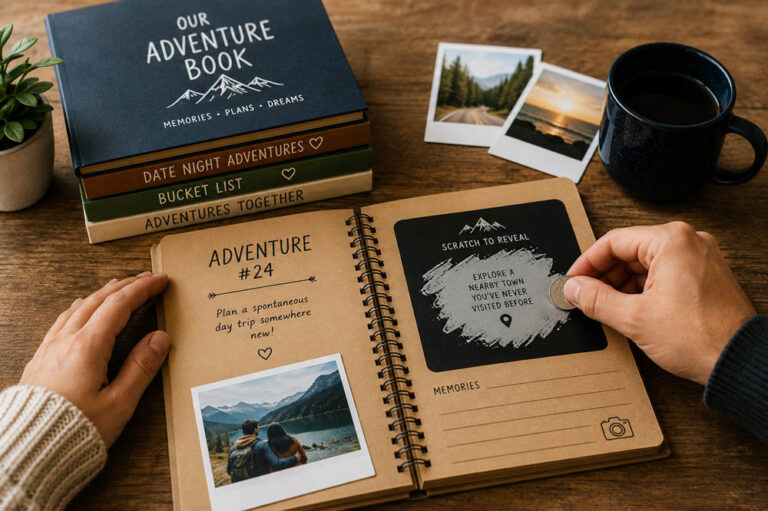
This interactive book moves beyond reading and asks partners to identify the experiences they want to share. Those goals can be ambitious, such as taking a long international journey, or personal, such as returning to a meaningful place or starting an annual tradition.
Although the title refers to married couples, the prompts can work for committed partners at many stages. The most valuable part is comparing individual ideas before creating a shared list. A goal that seems small to one person may hold deep emotional significance for the other. The book also provides a place to record what happened after each experience rather than simply checking it off.
How to Start a Two-Person Book Club
A couples’ book club does not require formal meetings or complicated rules. It only needs a book that interests both people and a routine that fits naturally into their lives.
- Begin with something new to both of you. Neither partner enters the discussion as the expert.
- Set a realistic pace. One or two chapters a week may be easier to sustain than a strict completion date.
- Agree on whether reading ahead is allowed. Staying together preserves surprises, but different schedules may require flexibility.
- Alternate who chooses. Each partner gets an opportunity to introduce a favorite genre or subject.
- Stop when neither person is enjoying it. Shared reading should not become an endurance test.
- Discuss reactions rather than details. The goal is to understand each other’s perspective, not test reading comprehension.
A few open questions are usually enough to begin:
- Which scene, character, or idea stayed with you?
- Did the book change how you think about relationships, happiness, or travel?
- What would you have done differently?
Talk over breakfast, during a walk, or while waiting for a flight. A relaxed conversation often feels more natural than a scheduled review immediately after finishing a chapter.
Making Reading Part of a Couple’s Trip
A shared book can complement a destination rather than serve only as entertainment between activities. Choose a novel set where you are traveling, read a memoir connected to the region, or bring a relationship book with one discussion reserved for each quiet afternoon.
Audiobooks are useful for road trips, particularly when the story has a clear plot that both partners can follow while driving. For flights and train journeys, separate copies or e-readers allow each person to read comfortably without arguing about pace.
Once you arrive, establish a simple reading moment. It might be coffee on a balcony, an hour beside the pool, or the quiet period before dinner. You can also connect the book to the itinerary by reading A Walk in the Woods before a scenic hike or discussing The Geography of Bliss over a local meal.
Your Next Chapter Together
The right shared book depends on what you need at the moment. You may want help discussing money, conflict, or intimacy. At another time, an imaginative adventure or reflective travel memoir may create a better experience.
Choose a title that genuinely interests both of you rather than the one that appears most educational. The best books for couples create curiosity, spark conversation, and give both partners a reason to look forward to the next chapter.